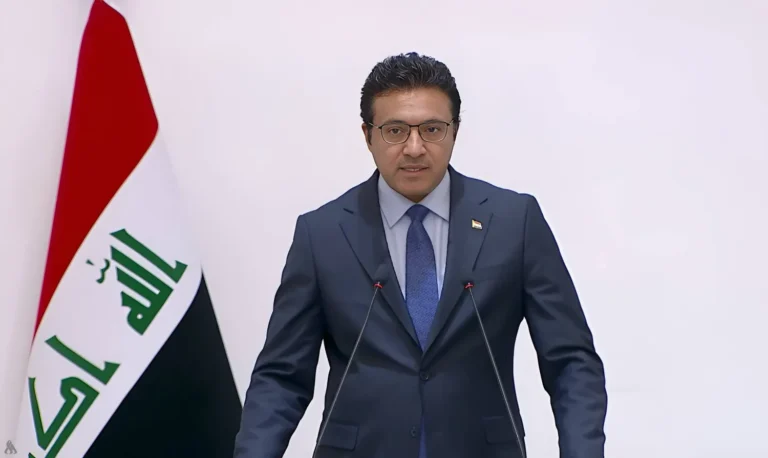
Baghdad, Iraq – Iraqi government spokesman Haider al-Aboudi confirmed during a press conference on Monday that oil revenues constitute the largest share and the cornerstone of the state’s general budget. He categorically denied any official government plan to distribute employee salaries every 45 days. Al-Aboudi explained that Iraq has not exported oil since last February, due to the closure of the Strait of Hormuz. This has led to a sharp decline in total oil exports, which reached only about 4 million barrels per month in April.
He added that Iraq is among the countries most affected by this crisis. He noted that the government has successfully concluded an agreement with Turkey to increase oil exports and alleviate the crisis. Al-Aboudi emphasized that employee salaries are fully secured. He described reports of a 45-day payment cycle as “baseless rumors.” He also confirmed that the government has not resorted to external borrowing to address the current financial pressures. He indicated that a proposal regarding internal borrowing, if needed, is under discussion in Parliament.
Parliament clarifies: Delay in disbursement does not change the monthly entitlement.
For its part, the parliamentary legal committee was quick to deny rumors of changes to the salary disbursement schedule. In this context, committee member Mohammed Jassim al-Khafaji confirmed that reports circulating about salaries being paid every 45 days were untrue. He explained that any potential delays in disbursement are due to the current financial crisis facing the country. This does not, in any way, mean that the fiscal month will be extended to that length. Al-Khafaji emphasized that employees remain entitled to their full salaries for 12 months annually without any reduction. While acknowledging the existence of a genuine financial crisis that has recently led to delays in salary payments for some government departments, he affirmed that this does not negate the employees’ fixed monthly entitlement.
Proposed solutions to address the financial crisis
Al-Khafaji explained that overcoming the current financial crisis does not necessarily require enacting new laws. Rather, it necessitates focusing on stopping financial waste and combating the rampant corruption within government departments. He pointed out that there is significant and tangible waste in government tenders and procurement processes. These processes can be controlled through effective oversight.
He pointed out that implementing a fair salary scale effectively contributes to addressing part of the problem, especially given the significant disparity between low and high salaries. He also cautioned, however, that raising minimum salaries while maintaining the highest ones would require substantial additional funds. He concluded by emphasizing the importance of developing non-oil revenues to support the national economy. Nevertheless, he stressed that these revenues remain a supplementary resource and can by no means completely replace oil revenues.