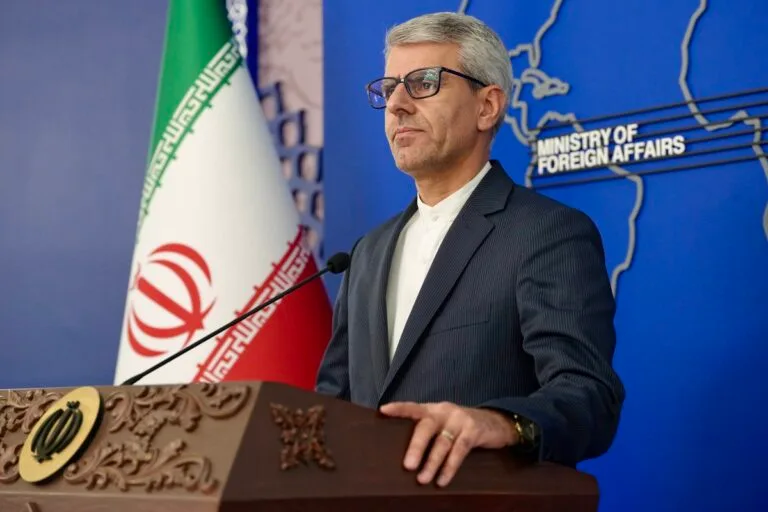
Tehran, Iran – Iranian Foreign Ministry spokesman Esmail Baghaei asserted during his weekly press conference on Monday that the Mecca Strategic Agreement is a direct result of the growing realization among regional states that “achieving security through the United States is no longer possible.” Baghaei also called on regional countries to strengthen ties of trust and cooperation. He urged them to do so without relying on any external powers or actors.
Regional cooperation and Tehran’s stance on the Türkiye-Saudi Arabia-Pakistan agreement
In response to questions regarding regional alliances, Baghaei emphasized that Tehran sees no logical justification for considering the joint defense and cooperation agreement signed between Turkey, Saudi Arabia, and Pakistan as directed against its strategic interests. However, he also stressed the importance of strengthening and developing comprehensive regional cooperation frameworks. In a clear warning to neighboring countries, the Iranian Foreign Ministry spokesman reiterated his country’s demand that no regional party be allowed to use its territory or airspace as a launching pad for any potential attack against Iranian territory. He also reaffirmed Tehran’s firm stance against all forms and manifestations of “foreign interference” in the internal affairs of the Middle East region.
Rejection of “selective justice” and the linking of treaties to national interests
In a separate context, Baghaei addressed his country’s foreign policy toward the international legal system, emphasizing that Iran cannot, under any circumstances, accept what he termed “selective justice.” Furthermore, he explained that Tehran has demonstrated to the international community that its participation in international treaties and agreements remains contingent solely on their alignment with its supreme national interests.
Strict conditions regarding the closure and opening of the Strait of Hormuz
The security situation and the future of maritime navigation dominated the Iranian official’s remarks. Baghaei settled the debate, asserting that opening the Strait of Hormuz to international trade and navigation is inextricably linked to current field conditions and Tehran’s specific terms. He emphasized, in no uncertain terms, that his country would not allow commercial vessels to pass through the strait as long as the war continues. Baghaei explained that the ongoing negotiations with Oman regarding the Strait of Hormuz primarily aim to identify and secure alternative shipping routes. He also described these diplomatic talks as “constructive and positive.” Justifying the closure, he added, “It is natural to close the Strait of Hormuz to prevent its exploitation in an attack against Iran.”
Regarding the financial aspects of managing the strategic waterway, Baqai indicated that the issue of fees “has not yet been officially raised” during the ongoing discussions with the Omani side. However, he added that it is perfectly normal to charge fees for providing navigational and pilotage services to transiting vessels. These developments come amidst intensive diplomatic efforts to reach arrangements that ensure the stability of energy supply lines.