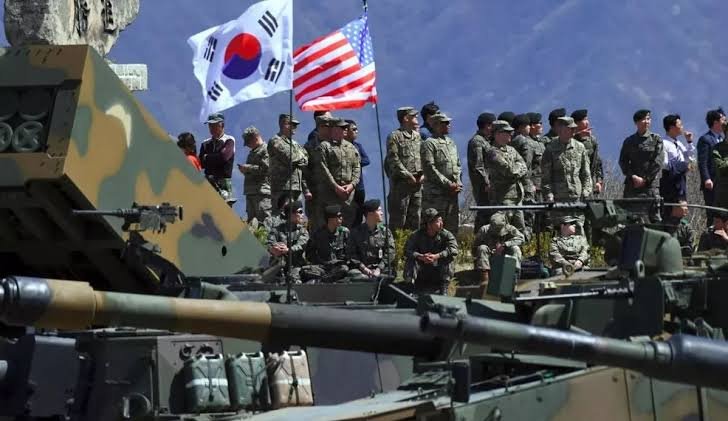
Seoul, South Korea – The South Korean Joint Chiefs of Staff and the U.S. Combined Forces Command announced the commencement of the regular, joint Ulchi Freedom Shield (UFS) military exercise. This annual defensive exercise aims to maintain readiness for the defense of the Korean Peninsula. It also aims to respond to potential contingencies. In addition, it focuses on integrating lessons learned from recent combat and assessing operational transfer conditions.
Realistic scenarios and enhanced joint operations
Military authorities in Seoul and Washington explained that this year’s exercise scenario reflects realistic and newly developed situations. The exercise draws on lessons learned from recent conflicts and battles. It also aims to strengthen the alliance’s collective defense posture. Moreover, it enhances joint operations across all military domains. Furthermore, it provides a vital platform for continued preparations for the transfer of operational control in wartime. This is done in accordance with pre-agreed terms.
Plans for transferring operational control and operational readiness
The South Korean government intends to finalize the operational readiness verification process for the future Combined Forces Command during the Joint Security Consultative Meeting. The defense ministers of both countries are scheduled to present the results of this verification to their respective commanders-in-chief. They will propose a target year for the transfer of command. Meanwhile, military leaders continue to assess Seoul’s strategic capabilities. Consultations are also ongoing to determine when a South Korean four-star general will assume command of the future Combined Forces Command. This will occur upon completion of the verification process.
Field exercises and their distribution throughout the year
The command post exercise is accompanied by a field training exercise (FTX) known as “Warrior Shield” (WS). This exercise aims to enhance combat realism and field readiness.
Exercise scope: Currently, 14 joint integrated field exercises are being conducted at the battalion level or higher. This is slightly less than last year (which saw 17 exercises at the battalion level and 22 at the company level).
The new strategy: Under current guidelines, field training exercises are integrated and distributed in a balanced manner throughout the year. This is done based on joint planning plans linked to core exercise scenarios.
All-out war and broad international involvement
Beyond the purely military aspect, these maneuvers support war readiness exercises and live-fire drills conducted by various government ministries. This preparedness enhances the ability to wage a full-scale national war across the entire country. It helps protect the lives of its citizens. On the international level, 12 member states of the United Nations Command (including the United States) are participating in the exercise. These countries will contribute approximately 70 additional personnel. Meanwhile, the Neutral Nations Supervisory Commission will monitor compliance with the Armistice Agreement. The Deputy Commander of the United Nations Command, Lieutenant General Scott Winter, emphasized the importance of the United Nations Command’s contributions in emerging fields. These include intelligence, cyberspace, and outer space.