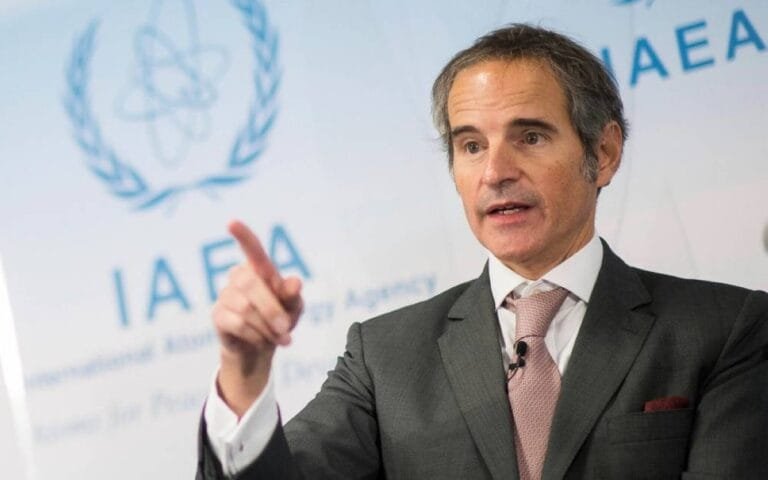
Tehran, Iran – The Director General of the International Atomic Energy Agency, Rafael Grossi, announced on Friday that the agency’s estimates indicate that Iranian nuclear materials have not been moved since the last inspection in 2025. However, he stressed that this conclusion “still needs further verification and on-site confirmation.”
Grossi’s remarks came during a press conference he held in Tokyo, the Japanese capital. He also confirmed that the memorandum of understanding signed between the United States and Iran explicitly stipulates that the Iranian nuclear program will be placed under the supervision and monitoring of the International Atomic Energy Agency (IAEA).
Grossi revealed that preliminary talks have begun with the Iranian side to determine the operational mechanisms. These talks included the frequency of inspections and the targeted sites. He stated, “There is an agreement, and in order to comply with it, the IAEA must be able to access and inspect the nuclear sites… We hope to be there soon.”
Uranium stockpile under the microscope
The Director General explained that the agency possesses a substantial record of over 400 kilograms of Iranian nuclear material. He also noted the presence of uranium enriched to 5% and 20% levels. This constitutes a “significant stockpile” of uranium.
Grossi indicated that Iran’s options include reducing the level of this material or transferring it abroad. However, he emphasized that implementing any of these steps remains contingent upon Tehran’s agreement.
Massive US funding to ensure non-proliferation
In a related development, Fox News reported that the Trump administration is seeking $672 million as part of a broader funding request to cover the costs of removing Iranian nuclear materials and supporting inspection and verification operations.
The network quoted a White House official as saying the funding would be used to handle sensitive materials such as uranium hexafluoride and research reactor fuel. It also aims to expand efforts to detect smuggling and strengthen nuclear emergency response teams in the Middle East, with the goal of undermining Iran’s ability to develop a nuclear weapon.
Conflicting positions: No settlement before a final agreement
This international activity comes amid sharp tensions between Washington and Tehran. Iranian Deputy Foreign Minister Kazem Gharibabadi confirmed that his country did not hold any meetings with Grossi in Switzerland. He also stressed that nuclear issues will only be resolved within the framework of a “final agreement” that guarantees the lifting of all sanctions. Furthermore, Gharibabadi denied the existence of any program currently allowing access to the facilities that were attacked.
In contrast, US President Donald Trump insists that Iran has “fully and definitively” agreed to submit to the highest level of nuclear inspections indefinitely. He has also dismissed Tehran’s statements on the matter as “false,” leaving the future of international oversight of Iran’s nuclear program vulnerable to complex political wrangling.