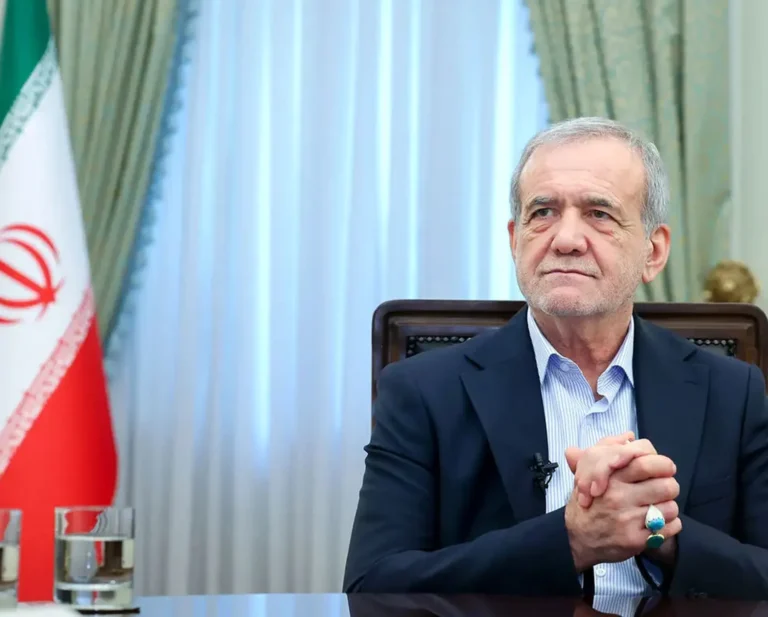
Tehran, Iran – Iranian President Masoud Pezeshkian reaffirmed on Sunday his country’s strategic position against expanding the scope of military conflict in the Middle East,
while simultaneously emphasizing that Tehran would not hesitate to exercise
its legitimate right to self-defense should its sovereignty be threatened by any external aggression.
These statements come amidst the height of ongoing diplomatic efforts in the Pakistani capital
and under unprecedented international pressure to end the current state of war.
Peace as a strategic option
Iranian state media quoted Pezeshkian as saying that Iran’s political
and security doctrine is based on “maintaining peace, stability, and security in the region.”
He clarified that his country “does not seek to expand the circle of war, has not initiated any historical conflicts,
and has not attacked any neighboring country.”
This statement aims to allay regional concerns about Tehran’s expansionist intentions.
It comes particularly in light of the recent escalation of tensions on multiple fronts.
Trump’s nuclear “guardianship” rejected
In a direct and sharp message to the White House, Pezeshkian strongly criticized statements made
by US President Donald Trump regarding Iran’s nuclear program.
Pezeshkian asserted that “the US president has no right to deny a nation its natural rights,
nor to dictate to Iran how to exercise its peaceful nuclear rights.”
The Iranian president considered US attempts to strip Tehran of its nuclear capabilities a blatant violation of international agreements.
He also emphasized that his country is exercising a “legitimate and legitimate right” that cannot be compromised under threat or sanctions.
Self-defense and red lines
Pezeshkian concluded by emphasizing that Iran does not intend to attack any country,
but it will not stand idly by in the face of any targeting of its facilities or territory.
Observers believe this stance reflects Tehran’s commitment to “defensive deterrence” as a cornerstone of its ongoing negotiations.
Iran is attempting to counterbalance American military pressure with a firm political position
that refuses to compromise on the technological and nuclear advancements it has achieved over the past decades.