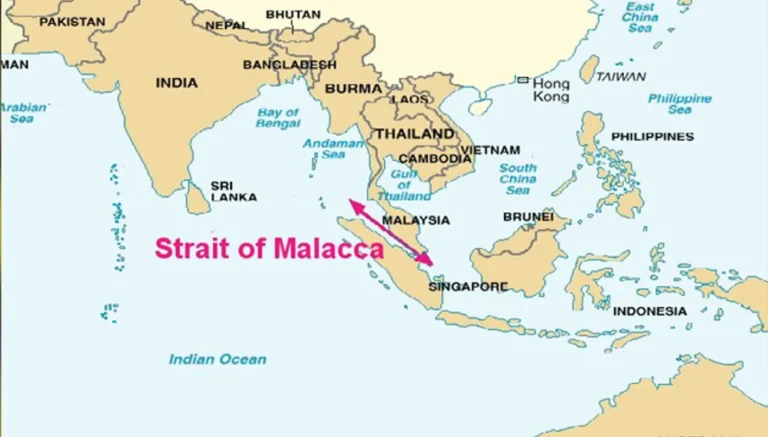
Jakarta, Indonesia – The Indonesian government has settled the debate surrounding the future of navigation in the Strait of Malacca. It confirmed that there are no plans to impose any fees on ships transiting this vital strategic waterway connecting the Indian and Pacific Oceans.
The Indonesian Ministry of Foreign Affairs emphasized that freedom of navigation in the Strait is a fundamental principle governed by international law, primarily the United Nations Convention on the Law of the Sea. These laws guarantee the continued flow of global trade without restrictions or additional fees.
The Strait of Malacca is one of the world’s busiest and most important maritime chokepoints, through which vast quantities of oil, gas, and goods pass between Asia and the rest of the world. This makes it a pivotal point for energy security and international supply chains.
An ongoing economic debate
Previous statements by Indonesian Finance Ministry officials had sparked debate about the potential for economically exploiting the Strait of Malacca’s location by imposing transit fees. However, the proposal was later withdrawn, with confirmation that it had not progressed beyond the initial study or discussion phase.
This proposal elicited regional reactions, given the sensitivity of the Strait, which is jointly overseen by Indonesia, Malaysia, and Singapore. The Strait is directly linked to global trade.
Regional Commitment to Safe Navigation
In response, the countries of the region emphasized the importance of maintaining the smooth flow of maritime traffic through the Strait, considering it a vital global trade artery whose established rules cannot be compromised. Security cooperation continues to ensure the safety of ships and to counter any potential threats.
The Strait of Malacca remains one of the world’s most strategic waterways, reflecting a delicate balance between the economic interests of the littoral states and the principle of free international trade.