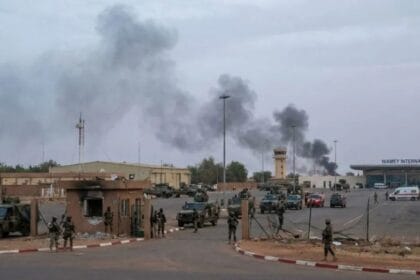
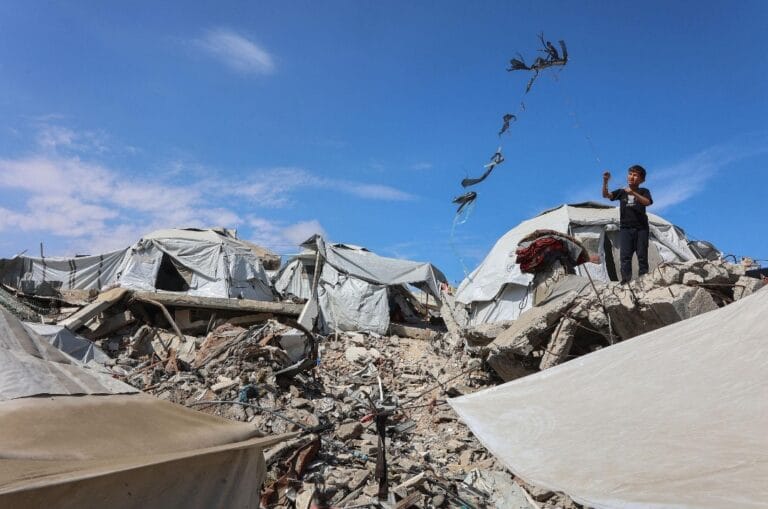
- 2018… When the kite carried fire
- 2026.. The plane returns without fire
- The memory of October 7th enters the picture
- From “paper airplane” to “terrorist act”
- The United Nations intervenes in the “plane” incident.
- The kite is not a “target” in itself.
- The child enters the danger zone
- The game that disappeared from the sky
- From 2018 to 2026: Eight years of “redefining the sky”
- The question that the war did not answer
- War doesn’t just change things; it changes their meaning.
Abu Dhabi, UAE – From a children’s toy to a security threat: How did the Gaza war redefine a simple piece of paper, and why did a child’s string become enough to trigger military concerns, threats of evacuation, and even physical attacks? In the skies over Gaza, a kite seems utterly simple: paper, wooden sticks, a long string, and a child trying to give it enough height to withstand the wind. But in August 2026, the picture was no longer so innocent. After kites began flying from the Gaza Strip into Israeli territory near the border, authorities in Gaza urged parents to stop their children from launching them, amid Israeli warnings that kite and balloon launches would be considered a security threat. The most significant irony is that the Israeli army stated, in at least one recent incident, that the kites that landed in the Nahal Oz area carried nothing suspicious and posed no danger to the public. Nevertheless, the kite became a security issue. This raises a question that extends beyond Gaza: When does a toy cease to be a toy? And who has the right to weaponize it?
2018… When the kite carried fire
To understand what is happening now, one cannot ignore the memory created by kites in southern Israel eight years ago. During the 2018 Great March of Return protests, Palestinians from the Gaza Strip launched kites and balloons carrying flammable materials toward southern Israel. Reports from the United Nations Office for the Coordination of Humanitarian Affairs (OCHA) document that these devices ignited fires in agricultural fields and forests. Between July 3 and 16, 2018, OCHA reported that Israeli authorities had recorded more than 750 fires since the start of this practice in late April, burning approximately 7,400 acres and causing more than $2.2 million in damages, with no Israeli fatalities reported. By August, Israeli authorities had reported 1,364 fires since late April, according to OCHA, with agricultural land and nature reserves burning, again with no Israeli fatalities. Therefore, there is an undeniable historical fact: kites have indeed been used in the past as a means of causing damage and starting fires. But history does not provide an automatic answer for every aircraft that appears in the sky in 2026.
2026.. The plane returns without fire
This August, kites reappeared. But the available data on the recent incidents differs from the 2018 pattern. Reuters reported that the kites seen near the Israeli border in the recent developments were not equipped with incendiary devices, although their appearance brought back memories for Israelis of previous incendiary kite attacks. In a documented incident near Kibbutz Nahal Oz, the Israeli army said that at least four kites crossed from Gaza, but reported that it found nothing suspicious on them and that there was no danger to the public. Herein lies the paradox: the device was present, but the danger was not confirmed in the case investigated by the army.
But the fear is indeed present.
The memory of October 7th enters the picture
The current Israeli reaction cannot be understood without considering the security memory left by the October 7, 2023, attack. Israeli communities near Gaza had endured years of incendiary kites and balloons, then experienced the October 7 attack, which meant that any flying object coming from the Strip carried, for some residents, a security significance that transcended its size and nature. Reuters reported that Israeli residents near the border, still traumatized by the 2023 attack, viewed the return of the kites as a source of anxiety, even when they were not carrying incendiary materials. This highlights a key element of the investigation: physical danger is not the only factor considered by communities emerging from war; memory itself can become an alarm system.
From “paper airplane” to “terrorist act”
On August 27, Israeli Defense Minister Israel Katz escalated his government’s stance. He stated that the Israeli army would respond forcefully to the launching of kites and balloons from the Gaza Strip toward Israeli communities near the border. Israeli statements described these devices as a security threat, with the Israeli leadership linking the phenomenon to Hamas and its capacity to carry out aerial attacks. Ironically, this escalation came at a time when some of the kites that had already reached Israel were found to be free of hazardous materials, according to published Israeli military assessments. This shifts the question from “What is the kite carrying?” to a more complex one: “What does launching the kite signify?”
The United Nations intervenes in the “plane” incident.
The story is no longer confined to Israel and Gaza. On August 24 and 25, Israeli threats regarding kites drew the attention of the United Nations. At a UN press briefing, the issue of Israel’s threat to evacuate areas in Gaza in response to kites that Israeli officials claimed were launched toward Israel was raised. In another press release, the UN relayed questions about Israeli threats of evacuation and attacks following the appearance of kites in the border area. Here, the issue becomes more than just the interception of a flying object. The question then becomes: Can the impact of an individual act extend to the population of an entire area? Who has the right to define a “target”?
This is the legal crux of the matter. International humanitarian law does not state that everything originating from a war zone becomes a military target. Nor does it state that everything with a civilian appearance enjoys absolute immunity. The criteria are the nature of the use, the circumstances, the objective, and the anticipated military advantage. The International Committee of the Red Cross clarifies that the principle of distinction requires differentiating between civilians and combatants, as well as between civilian objects and military objectives. This means that the legal question is not: Is it a kite? But rather: How was it used? If a child is using a kite for play, that’s one case; but if it’s equipped with incendiary or explosive materials and used to cause harm, that’s a completely different matter. Between these two cases lies a wide area that must be determined by evidence, not generalization.
The kite is not a “target” in itself.
This point deserves further examination. The existence of a precedent does not guarantee the same outcome for every instance. In 2018, OCHA documented the use of incendiary kites and balloons, and even cited Israeli reports of explosive devices in some of the kites and balloons that were subsequently neutralized. However, in 2026, we have documented cases where kites reached the Israeli side, and the Israeli army found nothing suspicious on them. Therefore, the events of 2018 cannot be simply conflated with those of 2026 without examining each incident individually. This is precisely where media simplification is lacking.
The child enters the danger zone
Most worryingly, security measures have not remained solely on the military side. Reuters reported that authorities in Gaza, in coordination with Hamas, have urged parents to prevent children from launching kites for fear of Israeli escalation. This has placed the child in a new predicament: if they fly the kite, it could cause fear; if it reaches the other side, it could become a security issue; if they launch it from a specific area, that area could become a target. The game that once offered children a few moments of normalcy has become a source of fear.
A four-year-old child… but no proven connection to the kite. On August 23, Reuters reported that a four-year-old Palestinian child was killed and others were injured in Israeli strikes on the Gaza Strip, following Israeli warnings about the launching of drones, balloons, and kites from the Strip. Reuters reported that the child died after being struck by debris and shrapnel from one of the strikes.
The game that disappeared from the sky
In Gaza, it’s not simply a matter of banning a toy. Children living amidst war have few spaces to play. And when a kite becomes a threat, another sphere of civilian life shrinks. The United Nations considers play a fundamental right of the child, and Article 31 of the Convention on the Rights of the Child stipulates the right of every child to rest, leisure, play, and recreational activities appropriate to their age.
Herein lies the human paradox: the more war intensifies, the more children need to play. But the more the conflict escalates, the smaller the space for play becomes.
From 2018 to 2026: Eight years of “redefining the sky”
The journey of the kite in Gaza can be summarized in four phases:
Phase 1 | 2018
Kites enter the conflict as a means of starting fires.
UN reports document hundreds of fires and millions of dollars in damage.
Phase 2 | Post-2018
The phenomenon decreases after a lull in fighting, and OCHA documents a significant drop in the launching of incendiary kites and balloons following the August 2018 ceasefire.
Phase 3 | Post-October 7, 2023
Israel’s security perception of the border and Gaza changes completely.
Phase 4 | August 2026
Kites return, but some new cases do not carry hazardous materials according to Israeli tests, while the phenomenon itself becomes a security issue and a source of political escalation.
The question that the war did not answer
If a kite carries an incendiary device, there is a measurable threat. If it carries explosives, there is a clear threat. But what if it carries only one thing: air? Is it enough for it to cross a border to become a threat? Is it enough for it to come from Gaza to lose its civilian character? Can a child’s toy become a reason to punish or displace the inhabitants of an entire area? These questions cannot be answered by fear alone. Nor by memory alone. Nor by political pronouncements. Rather, they require evidence for every incident, an assessment of every object, identification of every user, and a proportionality to every response.
War doesn’t just change things; it changes their meaning.
In 2018, kites were used by some Palestinians to start fires. In 2026, kites reappeared, but some of those that reached Israel were found not to contain hazardous materials, according to Israeli military assessments. Nevertheless, simply launching them became a cause for warnings, escalation, and threats. Between these two events, something more dangerous than the kite itself changed:
Its meaning changed. The toy became a reminder of war, the string became a potential security threat, and the child who raises his head to the sky lives with a question he doesn’t understand: Is what I’m doing playing… or have I become a target in the eyes of war? The real question here is not, “Is the kite a weapon?” but rather, “Who has the right to define a weapon?” Because the most dangerous thing that can happen in war is not that a toy becomes a weapon, but that suspicion of a toy becomes a justification for treating it as such before it is proven.