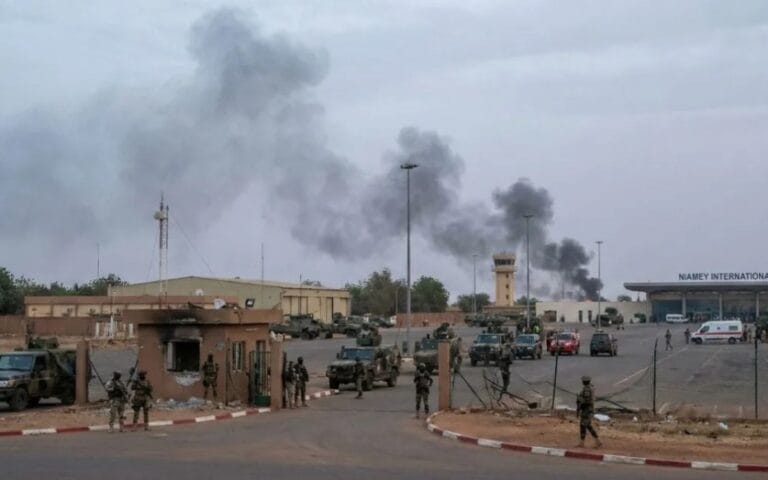
Niamey, Niger – The Nigerien capital, Niamey, experienced a night of terror following massive explosions and heavy gunfire that lasted from midnight Friday until dawn on Saturday, August 29, 2026. The clashes and violence were concentrated mainly around Diori Hamani International Airport. Additionally, fighting broke out in neighborhoods in the city center and near the presidential palace complex, amid uncertainty surrounding the identity of the attackers and the extent of the casualties. Meanwhile, military barracks were placed on high alert.
Targeting Air Base 101 and strategic military headquarters
According to eyewitness accounts gathered by AFP from local residents, the sounds of explosions and heavy gunfire were concentrated near Air Base 101, located within the international airport complex. This base is of significant importance as it houses the headquarters of the Africa Corps (Niamey’s Russian military partner). It also contains the headquarters of the G5 Sahel Joint Force, which includes Niger, Burkina Faso, and Mali. According to videos posted by local journalists, the first shots were fired around 1:00 AM and continued intermittently until the early hours of the morning. Furthermore, residents of the Kouira Kano neighborhood in western Niamey reported hearing small arms fire until 5:00 AM.
Armored vehicles move and government assurances of control over the situation.
On social media, local accounts circulated videos documenting the deployment of armored vehicles as a heavy security reinforcement around the airport and the administrative area housing the national television station (which continued its regular broadcast on Saturday morning). In the absence of detailed official statements from the military government, activists and those close to the authorities described the situation on the ground as “under control.” Nevertheless, a tense calm persisted.
A tense security situation and previous attacks by armed groups
It is worth noting that Niamey airport was targeted by armed attacks in 2016. The first attack, in January, was claimed by ISIS. A second attack, in late June, was claimed by Jama’at Nusrat al-Islam wal-Muslimin (JNIM), al-Qaeda’s branch in the Sahel, and resulted in the deaths of 11 soldiers and two civilians. The head of the military council, General Abdourahmane Tiéné, had previously acknowledged a “flaw in the security system” that allowed these breaches to occur. Consequently, concerns are rising about the recurrence of such terrorist threats, amid anticipation of any new official statements.