- From climate map to financial map
- Insurance: When a home address becomes a number in the risk equation
- The bank enters the game… Real estate is no longer a neutral collateral.
- The property begins paying the “climate discount”.
- The biggest paradox is that a price drop doesn’t mean the problem is over.
- Capital doesn’t always flee…sometimes it buys protection
- Those who have money can buy more time.
- Climate migration doesn’t always begin with a disaster.
- Artificial intelligence opens a new front: Who will compete with the population for electricity and water?
- Egypt… The Arab Test
- A new map of the world
- The real danger is not that the city will sink, but that it will lose its ability to adapt
- Who draws the map of the new cities?
Abu Dhabi, UAE – Insurance is driving up the cost of risk, banks are recalculating the value of collateral, real estate is starting to pay “climate discounts,” and artificial intelligence is opening up new competition for electricity and water. Climate change is no longer just an environmental phenomenon measured by temperature or sea-level rise, and its losses no longer stop at the moment of a flood or fire. An entire economy is emerging around risk. In this economy, insurance companies don’t just ask about the value of a home, but also about its vulnerability to floods, fires, storms, and extreme heat. Banks don’t just see a property as a building, but as collateral for a loan that could extend for decades. And investors ask a simpler, yet more agonizing, question: Will this place remain viable for investment in the future?
With the integration of climate risk models, big data, and algorithms into decision-making processes, some markets are beginning to see land, housing, and other assets repriced based on their exposure to climate risks. A study by the National Bureau of Economic Research (NBER), which analyzed over 74 million insurance premiums extracted from mortgage account data between 2014 and 2024, found that rising premiums related to disaster risks are beginning to impact home values, estimating a reduction in home price growth of over $40,000 in the most vulnerable areas. The broader implication of these figures is that climate is now factoring into the very value of a place. A city may not necessarily lose its value by flooding; sometimes, it’s enough for it to simply become more expensive to live in.
From climate map to financial map
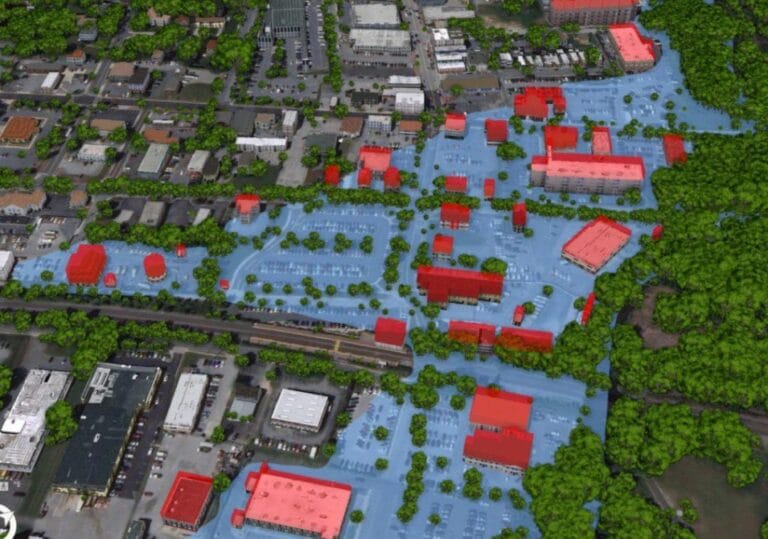
Climate risks are not evenly distributed within a single country, or even within the same city. A coastal area might face rising sea levels and storms, while another is vulnerable to extreme heat, flash floods, or wildfires. The Intergovernmental Panel on Climate Change (IPCC) indicates that cities face increasing risks from heat waves, floods, and factors related to urbanization, and that the “urban heat island effect” can amplify heat within built-up areas. But natural hazards are only the first layer; the second layer is how this risk is translated into a price. This is where insurance companies, banks, and investors come in. The higher the probability of loss, the higher the cost of protection, financing, or investment, and the market may begin to treat the location differently.
Insurance: When a home address becomes a number in the risk equation
For years, insurance was a largely invisible part of the home-buying decision. Today, however, in disaster-prone areas, insurance has become a major component of property ownership costs. Studies of the US insurance market show that insurers use different models to assess wildfire risk, and the accuracy of the information used in risk classification can influence pricing and the ability to differentiate between properties. In some US states, mounting losses have led companies to withdraw or scale back operations in high-risk areas, prompting local markets to rely more heavily on last-mile or alternative coverage. This changes the equation: a property that once cost $1 million, for example, now costs more than just $1 million. There are insurance costs, reconstruction costs, energy costs, adaptation costs, and potentially future relocation costs. Therefore, a property that appears expensive on paper may be less economically attractive in reality.
The bank enters the game… Real estate is no longer a neutral collateral.
Climate change might seem like a distant concern to the bank employee reviewing a mortgage application. But the bank is looking at something else entirely: What will happen to the collateral’s value over the loan term? If a home is at increased risk from flooding, hurricanes, or fires, insurance costs, financing terms, and collateral valuations could all change. The Federal Reserve notes that climate-related physical risks can impact property values and borrowers’ ability to repay, and insurance requirements against certain risks are now part of the property and credit valuation process. In a study of trends related to flood risk reclassification in New Orleans, researchers found that properties affected by the reclassification faced different financing conditions, including a slight increase in interest rates and a decrease in loan-to-value ratios. A few basis points might seem small, but they become significant when the loan has a 20- or 30-year term. The question then becomes: Can a citizen afford to buy a home in a high-risk area if the bank itself becomes more conservative in its lending?
The property begins paying the “climate discount”.
The real estate market doesn’t always wait for disaster. Sometimes, it’s enough for buyers to know that a risk exists. In Florida, economic research has shown that the risks associated with sea-level rise are already impacting real estate market activity before the full effects on prices are felt, with buyers demanding discounts to compensate for the risk. One study estimated the sea-level rise discount at approximately 6.7% in 2019. In a field experiment involving some 17.5 million users of a US real estate platform, displaying information related to flood risks changed search, listing, and purchase behavior, as well as property prices. This reveals a significant shift: climate information itself has become an economic factor. The clearer a buyer’s understanding of the risk, the more their decision changes.
The biggest paradox is that a price drop doesn’t mean the problem is over.
Lower property prices in high-risk areas might seem like good news for buyers. But what if new buyers are less able to afford the loss? A recent study on the impact of flood risk disclosure found that properties with the highest risk levels were discounted, and that buyers who opted for them were, on average, lower-income and more reliant on government-backed financing. This reveals a phenomenon that can be described as “risk transfer from the wealthier to the less able to afford it.” A wealthier family might sell and move to a safer neighborhood. A family that can’t afford to move might see the lower property price as an unmissable opportunity. Thus, the risk doesn’t disappear; it simply changes who bears it.
Capital doesn’t always flee…sometimes it buys protection
It is not true that investment automatically withdraws from every at-risk area. The decisive factor may be the area’s adaptability—a sea barrier, a new drainage system, power plants more resilient to heat waves, more efficient buildings, and better water management. These are all investments that can change an area’s value. Economic research shows that investing in flood protection can increase property values within the protected areas, while adjacent, unprotected areas may suffer negative impacts. Here, adaptation itself becomes a tool for wealth redistribution. A city that can protect itself may maintain its value. A city that cannot may enter a cycle of: risk → more expensive insurance → harder financing → lower property values → reduced investment → diminished adaptability.
Those who have money can buy more time.
The gap isn’t just about the level of risk; it’s about the ability to pay for it. The UN Environment Programme estimates that adaptation financing needs in developing countries could reach hundreds of billions of dollars annually by 2035, while international public finance flows for adaptation remain far below these needs. This poses a difficult question for cities: What happens when a city knows about a risk but doesn’t have the money to mitigate it? A municipality might know that an area is prone to flooding but lacks the funding for a drainage system. It might know that temperatures will rise but cannot upgrade buildings or create enough green spaces. It might know that water will become scarcer but cannot finance the infrastructure needed for its reuse. Financial capacity becomes part of the ability to survive.
Climate migration doesn’t always begin with a disaster.
The image of climate migration in the public imagination is that of a family fleeing a flood. But migration can begin in far less obvious ways. Soaring insurance costs, rising electricity bills, declining property values, disappearing job opportunities, water scarcity, increased food costs, and deteriorating services—then the decision to move is made. The World Bank predicts that, in scenarios where no strong action is taken, the number of climate migrants within their own countries could reach 216 million by 2050 across six regions worldwide, including some 19 million in North Africa, with climate migration hotspots potentially emerging as early as 2030. This means that a city losing its population isn’t necessarily one that has suffered a major disaster. It could be a city where staying has become more expensive than leaving.
Artificial intelligence opens a new front: Who will compete with the population for electricity and water?
While cities need more energy for cooling and to combat the heat, another energy-intensive sector is expanding: data centers. The International Energy Agency (IEA) reports that electricity consumption in data centers rose by about 17% in 2025, while consumption in AI-focused data centers increased by nearly 50%. The IEA projects that global data center consumption will rise from about 485 terawatt-hours (TWh) in 2025 to nearly 950 TWh in 2030. These figures don’t mean that AI is the cause of the climate crisis. But they do reveal a new paradox: societies need more electricity to cope with the heat, and data centers need more electricity to power the digital economy. In regions where data centers rely on water-intensive cooling systems, the question becomes even more complex: when water or electricity becomes scarce, who takes priority? The population? Agriculture? Industry? Or a data center that generates investment, jobs, and tax revenue?
Egypt… The Arab Test
Egypt is not exempt from this equation. The International Monetary Fund (IMF) presents Egypt with a range of climate-related risks, including rising temperatures, heat stress, rising sea levels, water scarcity, and the risks of drought and flooding. Here, economic questions become more important than simply measuring temperatures: Do land and property prices reflect levels of climate risk? Do insurance companies factor climate risks into their pricing? Are these risks considered in mortgage valuations? Which cities and regions will be best able to withstand rising temperatures or water scarcity? And where will adaptation costs be lowest? These questions deserve to be addressed in a comprehensive Egyptian database on climate risks, property prices, insurance, and financing, rather than simply relying on general reports about climate change.
A new map of the world
When we connect the dots, a different map emerges. Not just a map of heat, nor a map of floods, but a map that integrates: climate risk, insurance, finance, real estate, investment, migration, energy, and water. On this map, climate information can translate into an insurance price, an insurance price into a purchase decision, a purchase decision into a property value, a property value into a bank guarantee, a bank guarantee into a financing decision, financing into investment, and investment into migration or staying. Thus, climate change becomes a factor that redistributes opportunities and risks among cities and populations.
The real danger is not that the city will sink, but that it will lose its ability to adapt
It may be easy to identify a city facing flooding. But it’s much harder to identify one that has entered an economic spiral of climate risk. The signs can be subtle: more expensive insurance, properties selling at a discount, loans with tighter terms, investments shifting to other areas, residents leaving, and declining municipal revenues. Meanwhile, the city needs to spend more on protection. If it can’t finance this protection, the risks increase; if the risks increase, financing becomes even more difficult. And so the cycle begins.
Who draws the map of the new cities?
The logic of cities used to be simple: people went where there were jobs, and then capital sought out infrastructure. In the age of global warming, however, a new question may be added to every decision: Can this place withstand the future? This question isn’t answered by governments alone. Insurance companies, banks, investors, real estate platforms, risk models, and algorithms that analyze millions of data points to determine the probability of risk all contribute. As the world continues to build new cities, the financial market has begun assigning a different value to each square meter based on what might happen to it in the coming decades. The moment when someone declares a city “uninhabitable” may never come. Something more subtle may occur: insurance costs rise, financing becomes harder, demand falls, investment declines, those who can leave leave, and those who can’t stay, until the cost of saving the city becomes too much for its inhabitants to bear. So perhaps the question in the future won’t be: Which cities will sink? But rather: Which cities will money decide are no longer worth saving?