- China passes through Japan’s “doors”
- The defense line that started from the islands
- New weapon: You don’t need to chase the ship.
- “Miyako”… the door that cannot be ignored
- Japan will not close the strait… and the law prohibits simplification.
- From “siege” to “risk management”
- China itself is pushing Japan to reconsider.
- Taiwan: The episode that changes everything
- United States in the background
- Can China overcome the “Japanese wall”?
- From “remote islands” to an early warning network
- Japan and China are practicing the same crossing
- “The Eight Gates of China”: Where is the real battle?
- Japan does not want to “contain” China, but rather raise the price of its exit.
Abu Dhabi, UAE – From monitoring straits to possessing the capability to disrupt them, Tokyo is rebuilding its southern defense line, while the Chinese navy repeatedly tests its gateways to the Pacific Ocean. Not all naval warfare requires closing straits. Sometimes, it suffices to keep passage through them open, to know when naval vessels enter and where they are headed, and to possess enough missiles, aircraft, submarines, and sensors to make their passage in wartime a risk that cannot be ignored.
This is the point that reveals a less discussed aspect of the arms race between Japan and China. Tokyo has not declared a plan to close sea lanes to China, nor can it simply turn international straits into closed gates in peacetime. But for years, Japan has been rebuilding a substantial military presence on its southwestern islands, adding long-range missiles and reconnaissance and surveillance capabilities, in an area that lies precisely on the route increasingly used by the Chinese navy to access the Pacific Ocean. This raises a more serious question: Is Japan building a network that can weaponize its islands’ geography, making it more difficult for the Chinese navy to withdraw from East Asia without Tokyo declaring a formal blockade?
China passes through Japan’s “doors”
In recent years, Chinese naval movements through the waters surrounding Japan’s southwestern islands have become increasingly frequent. Records from Japan’s Joint Staff show Chinese vessels transiting the area between Okinawa and Miyako, as well as using other waterways in southern Japan. In July 2025, Japan reported spotting two Chinese Jiankai-2-class frigates moving through the area between Okinawa and Miyako, then toward Yonaguni. This was not an isolated incident.
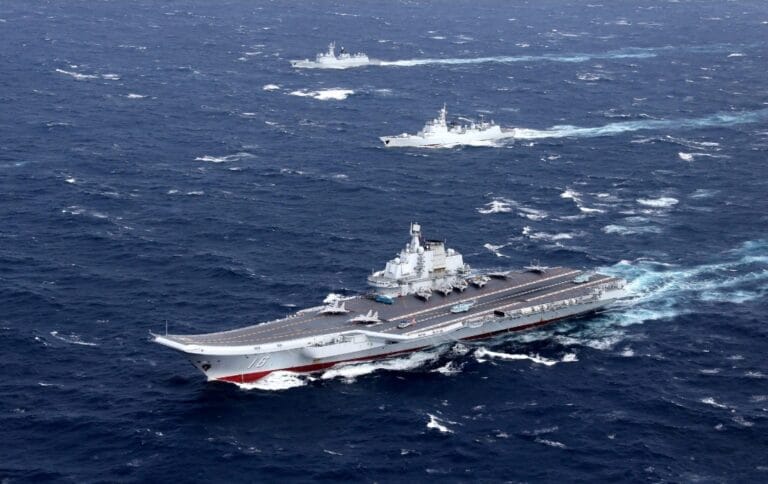
The Japanese military’s 2025 records include dozens of announcements regarding Chinese ship movements in southwestern Japan, including transits of the Okinawa-Miyako region, the Tsushima Strait, and the Osumi Strait—routes of increasing importance as the Chinese navy expands its activity in the western Pacific. In December 2025, Japan detected the Chinese aircraft carrier Liaoning transiting the area between Okinawa and Miyako, recording aircraft takeoffs and landings. The strategic significance of these movements lies not only in the distance traveled by the ships. They indicate that the Chinese navy is essentially testing routes to the Pacific Ocean via the Japanese island chain.
The defense line that started from the islands
On a map, Japan’s southwestern islands appear as a scattered chain between Japan and Taiwan, but from a military perspective, these islands can be transformed into a connected network of sensors and missile bases. The Japanese Ministry of Defense has openly stated that it has reinforced the Self-Defense Forces’ presence on Yonaguni, Miyako, Amami, and Ishigaki prefectures, deploying coastal surveillance units, security units, and surface-to-sea and surface-to-air missiles. Specifically on Miyako, the Japanese military infrastructure includes a security unit, air defense units, and an anti-ship missile unit. The Japanese Defense Minister described the increased deployment on these islands as part of addressing what Tokyo considers its most challenging and complex security environment since the end of World War II. Thus, the islands are transformed from geographical locations into observation and launch sites.
New weapon: You don’t need to chase the ship.
The biggest shift in Japanese doctrine isn’t just about the number of troops stationed on the islands. It’s about the distance at which Japan can engage its adversaries. In March 2026, the Japanese Ministry of Defense announced the deployment of its first domestically produced long-range missiles beyond the immediate threat zone. The deployment included an upgraded version of the Type-12 missile, now designated the Type-25 SSM, along with the Type-25 HVGP hypersonic glide vehicle. The ministry stated that these capabilities allow Japan to counter attacking forces from outside the immediate threat zone. In its defense plans, Tokyo also discusses developing long-range missile capabilities, including hypersonic missiles and island-based defensive capabilities. This alters the equation in the Strait. Instead of needing to position a warship directly in front of a Chinese vessel, Japan could theoretically make approaching a specific area vulnerable to land-based missiles.
“Miyako”… the door that cannot be ignored
If any area warrants investigation, it is the region between Okinawa and Miyako. Why? Because it lies within the island chain through which Chinese ships pass as they move from the East China Sea toward the western Pacific. Japanese records show frequent passages of Chinese vessels through this area in various directions, including warships, reconnaissance ships, and aircraft carriers. This does not mean that China is “blockaded” there. On the contrary, the sea is vast, China has multiple sea routes, and the Chinese fleet can use alternative routes around Japan. However, Miyako’s significance lies in the advanced position it provides Japan to monitor and respond to any naval force moving through this region. Here, geography becomes a military factor.
Japan will not close the strait… and the law prohibits simplification.
There is an important legal detail that must not be overlooked in any serious investigation into this issue. The United Nations Convention on the Law of the Sea grants ships and aircraft the right of “transit passage” through straits used for international navigation, and coastal states may not impede this passage when the conditions of the strait’s legal regime apply. Article 44 explicitly states that strait states may not impede transit passage, and that this right may not be suspended. Indeed, Japan itself historically chose to maintain its territorial waters at three nautical miles in five major straits, including Tsushima, Tsugaro, and Usumi, rather than fully applying the 12-mile limit. One of the reasons for this was related to the international strait regime and freedom of navigation. Therefore, the statement “Japan will close the straits to China” would be an inaccurate exaggeration. However, this does not negate the military question. The law is one thing, and a state’s ability to monitor and target enemy forces in wartime is another.
From “siege” to “risk management”
The most realistic scenario is not for Japan to erect an iron gate in the sea. Rather, it is for Japan to build a system that makes any Chinese move known, monitored, and manageable. The equation becomes: radar + satellites + reconnaissance aircraft + submarines + anti-ship missiles + long-range missiles + forward operating bases. This is not a completely imported concept; Japan officially states that it has strengthened its capabilities in the southwestern islands, and its defense plans include “stand-out” capabilities and long-range missile capabilities. The likely result is the creation of something resembling a “bubble of fire” around certain strategic waterways. It is not a legally closed area, but it could become a highly dangerous military zone in the event of war.
China itself is pushing Japan to reconsider.
Ironically, some of the Chinese actions that worry Tokyo are precisely what make these islands even more important. In 2025, Japan recorded frequent movements of Chinese vessels through the southwestern region, including Miyako, Tsushima, and Usumi. In 2026, the Japanese Joint Chiefs of Staff continued to report Chinese naval movements through the Tsushima Strait, including advanced vessels. Thus, Japan’s southwestern islands have become central to a broader equation: China wants access to the Pacific Ocean, and Japan wants to prevent its southern ocean from becoming an uncontrolled and open corridor.
Taiwan: The episode that changes everything
Japanese strategy cannot be understood without considering Taiwan. Japan’s southwestern islands lie close to Taiwan, and any conflict over the island could make this region one of the most volatile in Asia. In its defense document, Tokyo describes China as Japan’s “greatest strategic challenge,” citing increased Chinese activity around Taiwan, in East China, and in the Western Pacific. As recently as August 2026, Taiwan itself was ramping up its defenses against a potential Chinese attack, including enhancing its use of drones and long-range missiles. This underscores the importance of Japan’s islands: if a conflict were to erupt over Taiwan, the battle would not be confined to the island itself. The sea lanes, islands, and bases surrounding it could become part of a broader struggle for control over who can access and who can leave the Western Pacific.
United States in the background
There is another factor that makes Japan’s calculations different from any single power. It is the alliance with the United States. The American military presence in Japan includes missile defense systems, radars, and naval and air capabilities, while the American strategy in the Western Pacific depends on a network of allies, bases, and advanced sites. Therefore, the Japanese ability to monitor the southern islands should not be read as a solely Japanese capability. In any major crisis, this network may become part of a broader system that includes US forces, Japanese forces, and perhaps the capabilities of other countries in the region.
Can China overcome the “Japanese wall”?
Yes, the Japanese chain is not an iron wall. China is a major naval power, possessing a growing number of vessels capable of operating far from its shores. Nor is passage through a single strait a prerequisite for accessing the Pacific Ocean. But the military problem isn’t simply the possibility of passage; it’s the cost. The more Japan can detect, locate, track, and keep long-range weapons in position to engage Chinese vessels, the more restricted China’s freedom of movement becomes. This is the essence of modern “deterrence” strategy.
From “remote islands” to an early warning network
What’s remarkable about Japan’s transformation is that Tokyo isn’t building a massive military base on each island. Instead, it’s constructing a network: one island for surveillance, another for missile deployment, a third for air defense, and a fourth for troop support. These sites are then linked by aircraft, ships, satellites, and command centers. The Japanese Ministry of Defense has already announced the establishment and expansion of units on Yonaguni, Miyako, Ishigaki, and Amami, including coastal, missile, and air defense units. This isn’t a single “gateway.” It’s a series of gates. Therefore, describing it as a “strangulation network” is more accurate than talking about a “strait blockade.”
Japan and China are practicing the same crossing
China is not merely testing its ability to reach the ocean, and Japan is not merely testing its ability to defend its islands. Both sides are, in effect, learning from each other’s movements. Every Chinese crossing provides data and experience, and every Japanese surveillance operation provides counter-experience. The more these movements are repeated, the more each side becomes familiar with the other’s positions, capabilities, and operational patterns. Here, the sea becomes a permanent military laboratory, even without a single shot being fired.
“The Eight Gates of China”: Where is the real battle?
If a large-scale confrontation were to erupt in the Western Pacific, the question would no longer be: Can Japan close off China? But rather: How many of these gateways can Japan control? And how many can it render dangerous? The broader picture includes: Miyako-Yonaguni-Tsushima-Osumi, the East China Sea routes, the waterways around Taiwan, and the gateways to Southeast Asia—some of which are not even under Japanese control. But they all fall under a single equation: Who controls the movement of fleets between enclosed seas and the open ocean?
Japan does not want to “contain” China, but rather raise the price of its exit.
The available indicators do not prove the existence of a declared Japanese plan to close the straits to China. But they do indicate a larger shift. Japan is rebuilding its military presence on its southwestern islands, deploying anti-ship missiles, developing long-range weapons, and intensifying surveillance, while the Chinese navy is increasingly operating in the same areas. Therefore, a more accurate statement is not: “Japan is closing the straits to China,” but rather: “Japan is building the capability to turn the straits that China needs into observation and targeting zones in any future war.” Herein lies the paradox. In wartime, Tokyo may not need to close the door. It might suffice to let China know that the door is open… but crossing it could be the most dangerous decision it makes.