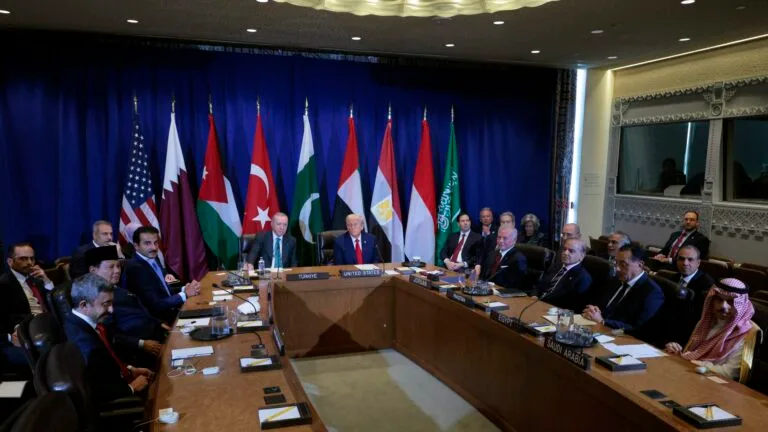
Cairo, Egypt – With Khalil al-Hayya’s arrival in Cairo for talks on the future of the Gaza Strip, negotiations are shifting from the question of ending the war to the more complex question of who will govern the Strip after the fighting ends. Who will be responsible for security, and who will have the authority to decide on reconstruction? The Egyptian and American moves are particularly significant given the efforts to translate US President Donald Trump’s plan into a workable arrangement. This necessitates an early examination of the form of authority that will emerge in Gaza, and the roles of Hamas, the Palestinian Authority, Israel, and international powers in the transitional phase.
A Palestinian administration without Hamas
The proposed scenario involves forming a technocratic Palestinian administration to manage services and civilian institutions in the Gaza Strip, separate from Hamas’s political and military structure. Its mandate would include managing public services, aid, health, and infrastructure, as well as creating the conditions for reconstruction. Major political and security issues would remain subject to broader arrangements. Thus, the plan does not appear designed to hand Gaza directly over to the Palestinian Authority, nor to keep Hamas in power, but rather to establish a Palestinian transitional phase with limited powers.
An international council holds the keys to the next phase.
Above the proposed Palestinian administration, an international structure would emerge to oversee the transitional phase, mobilize funding, and monitor the plan’s implementation. This is one of the key features of the American vision: Palestinian administration for internal affairs in exchange for international oversight of major issues, including reconstruction, security, and financing. In this scenario, the United States would play the most prominent role in managing the transitional phase, especially if Washington retained a leading role within the proposed international structure.
The most difficult knot: the weapon
The issue of Hamas’s weapons and those of other armed factions remains the most sensitive obstacle to implementing any governing formula. Israel links its withdrawal from the Gaza Strip to the disarmament of Hamas, while the movement maintains that the future of its weapons is inseparable from the nature of the agreement and the guarantees related to ending the war and the withdrawal. Without resolving this equation, it will be difficult to transition from political arrangements to a stable security reality. Therefore, the real question is not only who governs Gaza, but also who has the power to enforce the decisions of the new ruler, and who is responsible for security.
The plan proposes the establishment of an international stabilization force to assume security responsibilities during the transitional phase, in parallel with the development of a Palestinian police force. This means that security in Gaza may not be transferred directly to Palestinian security forces, but rather will undergo a hybrid phase involving an international force alongside Palestinian security institutions that are being formed or restructured. Israel’s withdrawal is expected to be linked to the implementation phases of the agreement and the verification of security commitments.
Israel will not disappear from the equation on day one.
Even if an agreement is reached, a complete Israeli withdrawal will not necessarily be instantaneous. The proposed arrangements are based on a phased withdrawal linked to progress on security issues, primarily disarmament. This creates a highly complex equation: Israel wants security guarantees before withdrawing, while the Palestinian Authority needs a stable territory to govern effectively.
The Palestinian Authority is present at the end of the road. Although it will not immediately assume control of Gaza, it appears in international perceptions as the entity to which the administration of the Strip could be transferred at a later stage, provided that political and institutional reforms are implemented and guarantees for effective governance are provided. Thus, the path can be envisioned as follows: Hamas exits power → a technocratic Palestinian administration → international and transitional security oversight → the possibility of power being transferred to the Palestinian Authority after reform. However, this path remains a politically contingent one, not a guaranteed outcome.
The battle for reconstruction
The economic file will be one of the most important keys to power in Gaza. The Strip needs billions of dollars to rebuild homes, electricity and water networks, hospitals, schools, roads, and economic facilities. Whoever has the ability to provide the funding will be able to directly influence the priorities of the next phase. Therefore, reconstruction is not just an economic issue, but also part of the equation of political influence in Gaza.
Cairo… the link
In this equation, Egypt emerges as a pivotal player due to its geographical location, its relationships with various parties, and its historical role in mediating between Israel and the Palestinian factions. Therefore, the Cairo talks are not solely about the terms of a ceasefire, but may also serve as a channel for testing Hamas’s willingness to integrate into the new arrangements, or at least for defining the limits of its role after the war ends.
Four scenarios for the next day
First: An orderly transition
A technocratic Palestinian administration, an international security force, a gradual Israeli withdrawal, followed by a subsequent transfer to the Palestinian Authority.
Second: A fragmented transitional administration
The civilian committee takes over services, but areas of security influence remain distributed, hindering the emergence of an effective central authority.
Third: The return of the Palestinian Authority
The transitional phase succeeds and the Authority implements institutional reforms, gradually taking over the management of the sector.
Fourth: The collapse of the arrangements
The agreement on weapons and withdrawal fails, so Gaza returns to a state of security and political vacuum, and the reconstruction project is disrupted.
Enforceable agreement
If Trump’s plan becomes a viable agreement, Gaza will not simply transfer from Hamas to another Palestinian faction. Rather, it will likely enter a multi-layered transitional phase involving a Palestinian civil administration, international oversight, and joint international and Palestinian security arrangements, with Israel remaining an influential player until the withdrawal is complete. However, the success of this political engineering hinges on three interconnected battles: the issue of weapons, the withdrawal itself, and political legitimacy.
Hence, Khalil Al-Hayya’s visit to Cairo becomes more than a negotiating round. It comes at a moment when the form of authority that will fill the vacuum in Gaza, the limits of Hamas’ role, and the future of the Palestinian Authority are being determined. As well as the party that will hold the keys to security and reconstruction.
The real test of Trump’s plan will not begin on the day of the ceasefire announcement, but on the day after it.