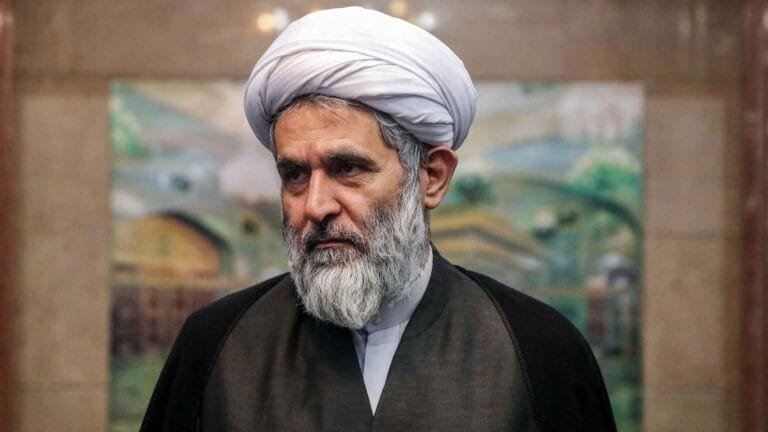
Tehran, Iran – In his first official statement since assuming his high-ranking position, Hossein Taeb, the new head of Iran’s Basij militia, asserted that “the Strait of Hormuz is under Tehran’s control and management, and the country continues its progress in complete safety.” Iranian Supreme Leader Mojtaba Khamenei officially appointed Taeb to head the Basij militia in recent days. This move is considered strategic and reflects a reshuffling of the country’s top security and military leadership. Furthermore, it also comes amid escalating regional tensions.
During his first field visit after assuming his new post, Iranian media reported that Taeb traveled to the historic holy city of Qom to meet with a number of religious scholars and authorities. He used this occasion to deliver political and ideological messages. Specifically, he described the funeral procession of the former leader of the Islamic Republic in Iraq as a clear and vivid demonstration of the strength of the Islamic Revolution. It was also an example of Iran’s far-reaching regional influence. He asserted that these actions reflected the regime’s resilience in the face of external pressures.
The new Basij commander’s remarks constitute a direct and early response to the escalating policies of the US administration. This comes specifically one day after US President Donald Trump made fiery statements on the Truth Social platform. He asserted that the United States has “total control over the Strait of Hormuz,” describing the imposed naval blockade as an “iron wall.” He indicated that Tehran is unable to circumvent or cope with this blockade.
Trump launched a scathing attack on the Iranian leadership, claiming that the Iranian Revolutionary Guard Corps (IRGC) was experiencing unprecedented disarray and collapse. He also stated that its leadership was “unstable and evasive.” Moreover, he further claimed that Iran no longer possessed a real navy or effective air force. He pointed out that the country was facing a severe internal economic crisis, characterized by astronomical inflation rates reaching 300%. Additionally, he noted the difficulties in paying soldiers and military personnel.