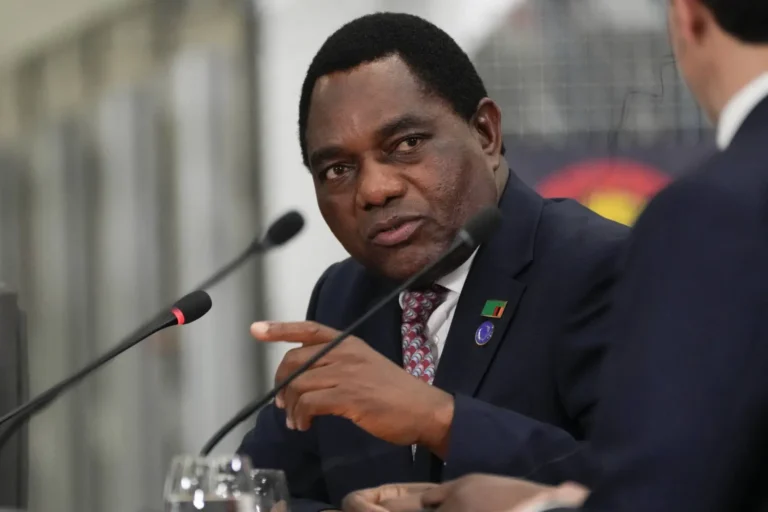
LUSAKA, Zambia – On Thursday, August 13, 2026, voters in Zambia went to the polls to cast their votes in the crucial presidential and legislative elections. About 9 million voters have the right to actively participate in determining the country’s political and economic fate for the next five years. Five years after the historic change of power that the country witnessed in 2021, outgoing President and United Party for National Development (UPND) candidate Hakainde Hichilema, popularly known as HH, is emerging. He is also considered the most likely candidate to win in a fierce competition that includes 13 other candidates. However, the rising cost of living, the mobilization of youth, the reorganization of opposition ranks, and the legal and constitutional wrangling over voting rules make the final outcome more ambiguous and complex than it appears on the face of it.
The outcome of years in power: between macroeconomic reforms and the daily struggles of families
Hakainde Hichilema defends his electoral record by pointing to his government’s successes in achieving a genuine macroeconomic recovery. This recovery is evidenced by the restructuring of external debt, the reduction of inflation rates, the strengthening of foreign exchange reserves, and the creation of over 50,000 public sector jobs. These jobs were primarily concentrated in the health, education, and security sectors. In addition, there was the launch of free primary education programs. In the area of civil liberties, the current administration has achieved positive results, including the abolition of the death penalty and the elimination of the crime of insulting the president. Furthermore, the long-awaited Access to Information Act, which had been pending for two decades, was finally passed.
On the other hand, Nicole Beardsworth, a Zambian political expert at the University of the Witwatersrand in South Africa, points to the major paradox of these elections: “Inflation has fallen, but prices remain high.” She explains that the removal of government subsidies on fuel and electricity has eased the burden on the public budget. However, this has increased household expenses. This comes at a time when the benefits of economic recovery are slowly reaching citizens’ pockets. Furthermore, wages have not kept pace with the rising cost of living.
The rise of the opposition and Brian Mondobell’s bets in the Copperbelt
On the political front, the opposition has managed to regroup, capitalizing on economic discontent. Most of the National Front party’s structures have rallied around Brian Mondobel following internal conflicts after losing power. Mondobel is targeting informal sector workers and disaffected miners. He employs populist rhetoric promising a return to the style of governance of former President Edgar Lungu. He promises this return without bearing the economic consequences of the previous administration’s policies.
Despite Mondobel’s popular success in securing a foothold in the Copperbelt and the eastern and northern provinces after his late candidacy announcement last May, University of Zambia law professor O’Brien Kaba believes that the available time was not sufficient to achieve a solid and comprehensive national standing across the country.
Doubts about integrity and legal controversy surrounding ballot papers
The weeks leading up to election day were marked by significant political tensions and sharp criticism directed at the electoral commission. Civil society organizations accused the commission of restricting opposition gatherings and creating an uneven playing field in campaigning. A major legal debate also erupted regarding the marking of ballots. The electoral commission recently clarified that a ballot could be valid even if the voter did not mark it with an “X,” provided their intention was clear. This belated clarification drew sharp criticism from prominent figures such as lawyer Linda Kasondi. She warned that the late amendments created confusion and opened the door to political interpretations.
While concerns persist about low voter turnout in urban areas due to long queues, the biggest unknown remains the choices of young voters who decisively supported Hichilema in the 2021 election. It also hinges on the extent to which the current president can retain their trust. This is important amidst growing signs of eroding civic and democratic space in the country.