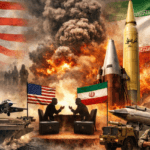
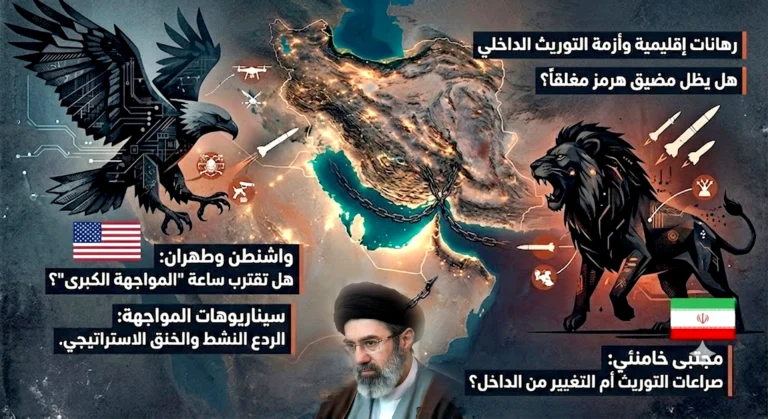
Exclusive, Voice of Emirates – The Middle East is witnessing an unprecedented state of strategic fluidity, as tensions escalate between Washington and Tehran.
This poses existential questions for the region regarding the possibility of a full-scale military confrontation.
The conflict is no longer confined to its traditional framework, but has moved to a stage of “direct engagement” in the realm of influence.
Consequently, this compels observers to analyze the situation beyond superficial political interpretations.
Will America reignite the war with Iran?
The answer to this question is not a simple “yes” or “no,” but rather lies in the very nature of the “definition of war” within current US military doctrine.
The United States is not necessarily seeking a full-scale ground invasion as in the past.
Instead, it is moving toward a strategy of “active deterrence.”
Washington is redefining the rules of engagement to make the cost of Iranian behavior unbearable.
Therefore, war here is not a sudden outbreak of hostilities, but rather a continuation of a sustained process of “strategic strangulation.”
It could escalate into a direct military confrontation if Iran crosses red lines related to international maritime security or its nuclear program.
War scenarios and American arguments
Washington clings to a set of legal, moral, and political arguments to justify any potential escalation.
The first argument is “protecting the security of international waterways” (such as the Strait of Hormuz),
the second is “curbing Iran’s missile proliferation,” and the third is “reducing its destabilizing regional influence.”
As for war scenarios, they extend beyond a conventional invasion to include:
Limited surgical operations: precise targeting of military or nuclear facilities or missile launch sites.
Comprehensive cyber warfare: crippling Iranian infrastructure (electricity, communications, financial networks) without firing a single shot.
A naval and air blockade: completely preventing oil exports and imposing a security cordon to prevent supplies from reaching the regime or its proxies.
Ultimate goals of the match
Washington’s aim in these tensions is not merely to topple the regime from within, but to “functionally dismantle” the Iranian system of influence.
The ultimate goal is to transform Iran from an “imperial regional player” with proxies in Lebanon, Iraq, and Yemen, into a “nation-state” confined within its borders. It must also adhere to the rules of the international order.
Washington seeks to re-engineer the functions of the Iranian regime so that its existence becomes dependent on its internal stability, not its ability to export chaos.
The Strait of Hormuz crisis: Will it remain closed?
The Strait of Hormuz is a vital artery for the global economy; therefore, keeping it closed for an extended period is not a viable option for either Iran or the United States. If Iran were to attempt to close it,
it would face the entire international community (China, India, Europe), not just the United States.
Thus, the most likely scenario is that navigation through the strait will remain subject to a cat-and-mouse game or a show of force.
However, a complete and permanent closure is unlikely, as that would mean the end of the Iranian regime,
which cannot afford to lose its only financial lifeline.
The United States understands that its international alliances are capable of
ensuring the strait remains open through the formation of international maritime security coalitions.
Assassination of Mojtaba Khamenei
The political analysis here distinguishes between “military strategy” and “media speculation.”
There is no strategic evidence that the United States adopts “assassination of individuals” as a cornerstone of
its policy toward the Iranian regime; rather, it focuses on “changing the regime’s behavior” as a whole.
The discussion surrounding Mojtaba Khamenei falls within the context of internal succession struggles in Iran,
where the regime fears that a power vacuum or a turbulent transfer of power could lead to internal collapse.
The United States is monitoring this struggle and may exploit the regime’s “fragility” during the succession phase.
However, it doesn’t need to assassinate an individual as much as it needs to exploit
the escalating conflict between the Revolutionary Guard, the religious establishment,
and the various centers vying for legitimacy, to ensure the regime’s internal weakness.
The Iranian regime today faces a crisis of legitimacy with its people and a crisis of confidence
within its own factions. This, in itself, is the real threat, one that doesn’t require direct external intervention.
The stage of mutual losses
The situation between Washington and Tehran is one of protracted conflict.
If war breaks out, it will be more a product of miscalculations than a deliberate desire.
The region has entered a phase of mutual losses, with Tehran understanding that any full-scale confrontation would end its regional ambitions.
Washington, for its part, understands that the economic and political cost of any major war would be exorbitant.
The question remains: Will “soft power” continue to deter recklessness, or will “political folly” write the final chapter of the region’s history?
The coming days will determine whether the maps of influence remain redrawn, or whether the flames will consume everything.