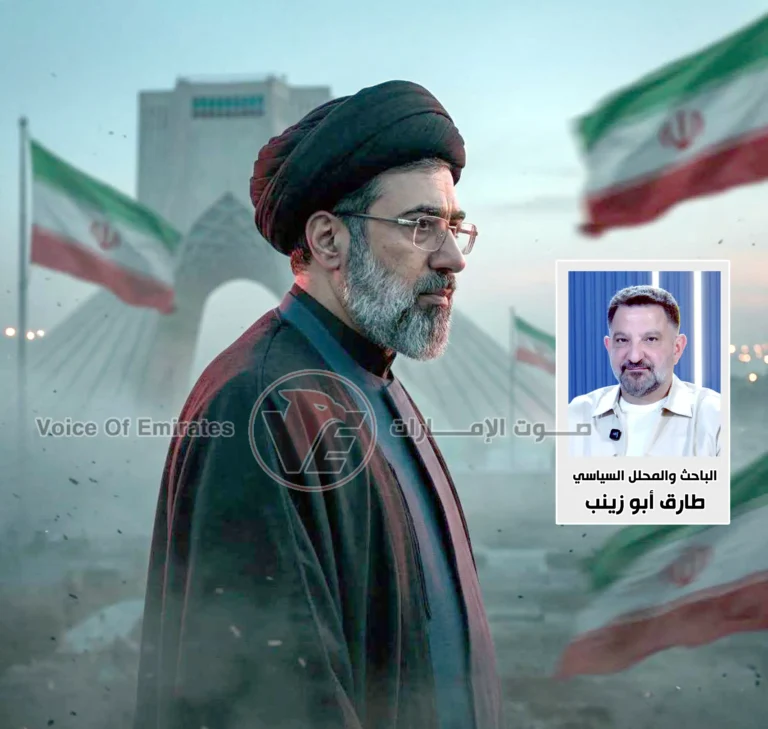
Exclusive, Voice of Emirates – In an exclusive analytical statement to the Voice of the Emirates website, researcher and political analyst Tariq Abu Zeinab confirmed that the Islamic Republic of Iran is no longer facing only its classic challenges, such as economic sanctions or Western geopolitical pressures.
Rather, it has entered a more dangerous existential phase,
characterized by a deep “structural” conflict that is striking at the very foundations of the state from within.
Abu Zeinab explained that the question circulating in Tehran today is no longer “How do we withstand external pressures?”
but rather “Who has the right to determine Iran’s fate after Khamenei?”
“The Paradox of Succession”: The Fall of the Revolution’s Legitimacy
Researcher Tariq Abu Zeinab believes that the issue of political succession, which has intensified
with the emergence of Mojtaba Khamenei as the successor to his father, represents a major fissure within the regime.
He states: “The regime, founded in 1979 on the ruins of the monarchy and which derived its legitimacy for four decades
from slogans against dynastic succession and the rejection of tyranny,
now finds itself embroiled in a historical paradox of the most severe kind;
it is effectively transforming into a fully-fledged dynastic system.
This transformation is not merely a constitutional procedure, but rather a tacit admission of the collapse of revolutionary slogans.
It also marks the beginning of a ‘republican monarchy’ based not on institutional competence, but on narrow familial and security loyalties.”
The struggle of wings: When the suppressed explodes
Regarding the nature of the conflict within the regime’s structure, researcher Tariq Abu Zeinab points out that disagreements
that had long remained confined behind closed doors have now surfaced.
This reflects the weakening of the central authority’s control.
He adds: “We are witnessing a breakdown of balances. The Iranian Revolutionary Guard is no longer merely a military institution.
It has become a state within a state, controlling key aspects of the economy and politics,
which has created a climate of jealousy and hostility toward traditional religious and bureaucratic institutions.
The conflict today is not just about the distribution of power; it is an existential battle over
who holds the keys to strategic decision-making at this pivotal historical moment.”
“Earthquake” Council of Experts
The political analyst focused on the unprecedented incident involving the statement issued by members of the Assembly of Experts, deeming it a “political earthquake.”
Abu Zeinab explained: “For more than 70% of the Assembly’s members—the most sacred and sensitive institution—to sign
a statement expressing disagreements or concerns indicates
that the ceiling of ‘sacredness’ has been lowered within the corridors of power.
This move signifies that blind loyalty to the center of power is no longer absolute.
It also suggests that there are factions within the regime that have begun
to seek alternatives or reassess their positions before a major upheaval.”
The state is held hostage by “power centers”.
In an analysis of the institutional situation, researcher Tariq Abu Zeinab asserted that the regime suffers
from paralysis in decision-making due to the multiplicity of centers of power.
He emphasized: “The Supreme National Security Council, the presidency,
and the military leadership all operate within a network of conflicting interests.
This multiplicity is not democratic; rather, it is a recipe for chaos.
When a unified vision is absent, every regional or international issue becomes a new test of the power struggles between factions.
This leaves Iran vulnerable to any unforeseen development.”
Warning: The threat does not come from the border.
Researcher Tariq Abu Zeinab concluded his statement to the “Voice of the Emirates” website with a cautionary, forward-looking perspective,
saying: “The history of political systems tells us that collapse doesn’t always come from an external blow,
but rather begins with the erosion of legitimacy from within the institutions themselves.
Iran today is walking a minefield; the battle it is waging over ‘who sits on the Supreme Leader’s chair’ will cost it its national stability.
The regime faces an inescapable dilemma: either adapt to the demands of a modern state,
or drown in succession struggles that could disintegrate the state from within.
Ultimately, legitimacy is not inheritance, but a social contract.
And it seems the Iranian regime has lost the ability to renew this contract with its people, and even with the pillars of its rule.”
According to Abu Zeinab, Iran today is living through a moment of “great truth.” In this atmosphere, slogans are useless,
and external threats cannot mask the fragility of the internal structure,
which is cracking under the weight of factional conflicts and dynastic ambitions.