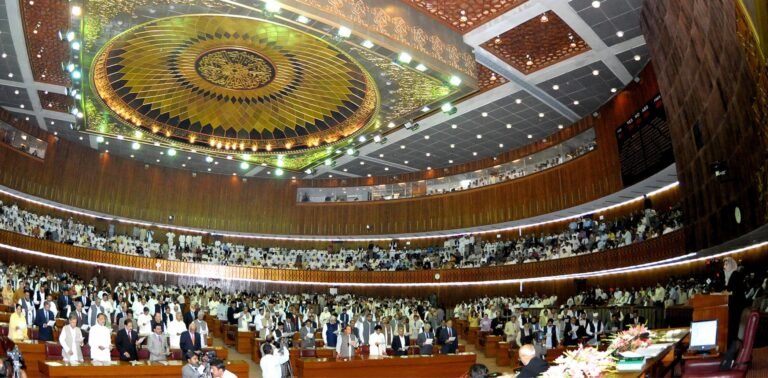
Islamabad, Pakistan – The Pakistani parliament began its formal sessions on Saturday to discuss the federal budget for the upcoming fiscal year. However, the chamber was overshadowed by heated political debates that dominated the budget proposals presented by Finance Minister Muhammad Aurangzeb.
Despite the importance of the financial agenda, domestic and political issues dominated the lawmakers’ interventions. Furthermore, this occurred amidst escalating protests from opposition MPs.
Debate between the political poles under the dome of parliament
The main event was a speech lasting over an hour by opposition leader Mahmood Khan Achakzai, who strongly criticized the government’s move to freeze development funding in the provinces. He also warned of the consequences for the health and social welfare sectors. In a historical narrative beginning in 1860, Achakzai linked the current security situation to the lack of consensus among the country’s political forces.
In a swift response, Prime Minister Shehbaz Sharif used his presence at the session to address the opposition’s criticisms, reaffirming his government’s commitment to achieving balanced development across all four provinces.
Sharif emphasized that “the presence of everyone in Parliament is essential for the existence of Pakistan.” He also asserted that there was no fundamental disagreement regarding the provinces’ right to their local resources.
Development of Balochistan and border issues
The Prime Minister reviewed a series of development projects in Balochistan, the home province of the opposition leader. He highlighted the Riko Dik project and the doubling of the province’s share of the National Finance Commission’s prize. He also mentioned support for farmers in the form of solar energy and the vital road project connecting Chaman and Gwadar.
In a sensitive matter, Sharif responded to Achakzai’s criticism of the border fence with Afghanistan (the Durand Line), defending its multibillion dollar cost by saying, “If this fence saves even one child’s life, then the money was spent wisely.” He also condemned the questioning of the armed forces’ role, citing the sacrifices of soldiers in the fight against terrorism, particularly in Khyber Pakhtunkhwa, and emphasizing the need to honor the blood of martyrs.
Attempts to calm tensions and demands for rights
In a gesture aimed at bridging the divide, Shehbaz Sharif renewed his call for dialogue with the opposition and the drafting of a “charter for democracy.” This offer was met with a response from the opposition, which included specific demands. Gowar Ali Khan, the head of the Pakistan Tehreek-e-Insaf (PTI) party, criticized the ruling establishment’s role in politics and called for respect for the rights of his party’s imprisoned leader, Imran Khan.
Meanwhile, Dr. Farooq Sattar, from the MQM movement, advocated for the passage of the 28th constitutional amendment to establish a strong local government system, deeming it the best path for the country’s progress. The National Assembly resumes its discussions today, Sunday. The Pakistani public is waiting to see how these political tensions will affect the final budget.