Sign In
Sunday, Jun 7, 2026
  • العربية
Top Header VOE Logo Header Dark Mode VOE Logo
  • Latest
  • Emirates
  • News
    • Gulf Countries
    • Arab Countries
    • World
  • Politics
    • Analysis
    • Interviews
    • Reports and investigations
  • Business
    • Companies
    • Real Estate
    • Stock Market
    • Green Energy
    • Oil And Gas
    • Bitcoin
    • Business Reports
  • Science and Tech
    • AI
    • Electric Vehicles
    • Space and Mars
  • Sport
    • World Cup 2026
  • Society
  • Health
  • Lifestyle
  • Travel and Hotels
Reading: After the Hormuz crisis, why is it no longer easy to disentangle the economic ties between the superpowers?
Share
Latest
A US draft resolution calls on Iran to fully cooperate with the International Atomic Energy Agency
Israeli source: The raid on the southern suburbs targeted a Hezbollah headquarters
Discontent is building up on the Iranian street: Will the war end the cohesion of the regime?
A new poster for The Odyssey has been released, and ticket sales are in huge demand.
How much will the referees for the 2026 World Cup be paid? Record-breaking figures await them
Font ResizerAa
Voice Of EmiratesVoice Of Emirates
  • العربية
  • Latest News
Search
  • News
    • Emirates
    • Gulf Countries
    • Arab Countries
    • World
  • Politics
    • Analysis
    • Interviews
    • Reports and investigations
  • Business
    • Companies
    • Real Estate
    • Stock Market
    • Green Energy
    • Oil And Gas
    • Bitcoin
    • Business Reports
  • Science and Tech
    • AI
    • Electric Vehicles
    • Space and Mars
  • Lifestyle
  • Society
  • Sport
    • World Cup 2026
  • Health
  • Travel and Hotels
Have an existing account? Sign In
Follow US
All rights reserved © Voice of Emirates - News service from Our Media Group
PoliticsReports and investigations

After the Hormuz crisis, why is it no longer easy to disentangle the economic ties between the superpowers?

Closing the Strait of Hormuz represents an asymmetric but highly effective tool of pressure

علي رجب
Last updated: 07/06/2026 6:28 pm
Ali Ragab
علي رجب
ByAli Ragab
News Editor
Ali Ragab, editor at Voice of Emirates News Agency, Cairo office, is an Egyptian journalist and poet, a member of the Egyptian Journalists Syndicate, specializing in...
- News Editor
2 hours ago
Share
4 Min Read
After the Hormuz crisis, why is it no longer easy to disentangle the economic ties between the superpowers?
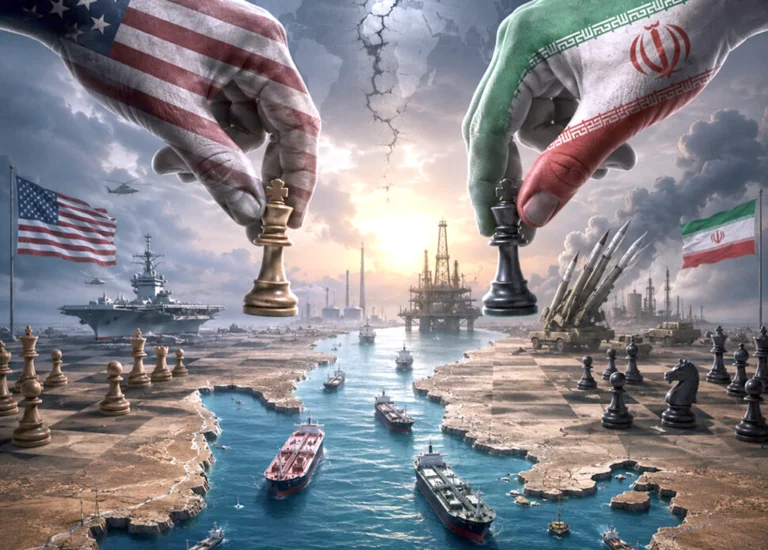
After the Hormuz crisis... Why is it no longer easy to break the economic ties between the great powers? (Photo/archive generated by artificial intelligence)
SHARE
Highlights
  • Geopolitical “choke points”
  • From dollar dominance to strategic supply chains
  • The illusion of liberation from dependency
  • The next challenge: building resilience

Dubai, Voice of the Emirates – The crisis of Iran’s closure of the Strait of Hormuz has revealed one of the most sensitive weaknesses in the global economy.

It also shed light on a phenomenon that has come to be known as the “weaponization of economic interdependence.”

In this phenomenon, countries exploit vital trade lanes and supply chains as geopolitical pressure tools.

Recent reports from the Wall Street Journal confirm that this structural defect

in the international economy will not be repaired in the near term. Instead, it will require years of strategic restructuring.

Geopolitical “choke points”

The crisis in the Strait of Hormuz is not merely a passing incident concerning the flow of oil; it embodies a strategic shift in how conflicts are managed.

While the ceasefire between Washington and Tehran remains fragile, governments and businesses recognize

that reliance on trade routes that can be closed at any moment has become an existential threat.

In this context, Admiral Giuseppe Cavo Dragone, NATO’s Supreme Allied Commander Europe, warned that the world faces a growing challenge.

Moreover, this challenge requires unprecedented coordination between military institutions and the private sector.

The goal is to counter the exploitation of bottlenecks in global trade.

From dollar dominance to strategic supply chains

Historically, the United States has been the most prominent player in weaponizing

the economy through the dollar’s dominance of the global financial system.

However, the landscape has changed with the entry of new players;

China has emerged as a powerful force through its control of rare earth supply chains.

These vital materials are irreplaceable in the semiconductor, jet engines, and advanced technology industries.

As for Iran, it added a different dimension by exploiting its geographical location.

Closing the Strait of Hormuz represents an asymmetric but highly effective pressure tool against American military superiority.

As a result, this gives Tehran the ability to influence global energy markets directly and significantly.

The illusion of liberation from dependency

Although countries such as the United States and Japan have invested billions of dollars to create mining and refining capabilities outside China,

the report notes that economic “untangling” is an extremely complex process.

Japan provides a stark example; Despite its continuous efforts since 2010 to reduce

its dependence on Chinese metals, Tokyo still imports about 60% of its needs from Beijing.

In contrast, China itself is suffering from similar pressures.

US restrictions on exports of advanced semiconductor technologies have slowed its growth in the artificial intelligence sector.

In addition, this reflects a state of “toxic interdependence” that affects everyone.

The next challenge: building resilience

Political economists, including Abraham Neumann, author of a book on the weaponization of economic dependency,

argue that the greatest challenge lies in avoiding the “new dependency trap.”

For example, the Russian-Ukrainian war led to a shift from dependence on Russian gas to dependence on American natural gas.

Meanwhile, China maintains a dominant position in green energy and battery supply chains.

The Wall Street Journal report concludes that, despite all efforts at diversification,

the global economy remains constrained by a limited number of strategic bottlenecks.

Building a more independent and resilient system requires more than just massive investments.

It demands sustained political will that recognizes that the transition away from these entrenched dependencies will take many years.

Furthermore, energy and trade security are no longer purely economic matters.

They have become a cornerstone of national security in an increasingly polarized world.
TAGGED:American military supremacycease-fireEnergy security and tradeGlobal economyHormuz CrisisMilitary institutionsRussian-Ukrainian WarStrait of HormuzSupreme Military CommanderVoice Of EmiratesVoice Of Emirates Website NewsWashington and Tehran
SOURCES:Voice of Emirates
Share This Article
Facebook Whatsapp Whatsapp LinkedIn Telegram Threads Email Copy Link Print
Previous Article Landslides and panic in Greece after two successive earthquakes.. Here are the details Landslides and panic in Greece after two successive earthquakes.. Here are the details
Next Article The 80th Presidential Club in America.. Trump joins Biden amid renewed doubts about health and mental fitness The 80th Presidential Club in America.. Trump joins Biden amid renewed doubts about health and mental fitness
32°C
Dubai
clear sky
32° _ 32°
74%
5 km/h
Sun
32 °C
Mon
35 °C
Tue
35 °C
Wed
34 °C
Thu
35 °C

Editor's Pick

A US draft resolution calls on Iran to fully cooperate with the International Atomic Energy Agency

A US draft resolution calls on Iran to fully cooperate with the International Atomic Energy Agency

Iran and the US draft resolution at the agency

By
Mohammed Yossry
2 Min Read
Israeli source: The raid on the southern suburbs targeted a Hezbollah headquarters

Lebanon: Israeli strikes target the southern suburbs

2 Min Read
Discontent is building up on the Iranian street: Will the war end the cohesion of the regime?

Iran: Economic crisis and warnings of inflation

4 Min Read

Trending

A new poster for The Odyssey has been released, and ticket sales are in huge demand.

A new poster for The Odyssey has been released, and ticket sales are in huge demand.

The biggest cinematic works

1 hour ago

How much will the referees for the 2026 World Cup be paid? Record-breaking figures await them

World Cup and wage regulation for…

1 hour ago

Losses of 7,000 megawatts: Iran announces the extent of damage to its electricity sector after the war

Iran: Rebuilding damaged power plants

1 hour ago

The 80th Presidential Club in America.. Trump joins Biden amid renewed doubts about health and mental fitness

Trump and the health challenges of…

2 hours ago

Landslides and panic in Greece after two successive earthquakes.. Here are the details

Greece: Successive earthquakes in Evia

2 hours ago

You may also be interested in

Drought in Barcelona brings back to the surface a thousand-year-old church that had been submerged since the Franco era.
NewsWorld

Drought in Barcelona brings back to the surface a thousand-year-old church that had been submerged since the Franco era

Madrid, Spain – Catalonia has experienced one of its worst droughts in years in recent months. This drought has led…

2 Min Read
Political storm in Washington: US Defense Secretary's sons accompany him on a visit to France sparks controversy
PoliticsReports and investigations

A political storm in Washington: The US Secretary of Defense’s sons accompanying him on a visit to France sparks controversy

A political storm in Washington: The US Secretary of Defense's sons accompanying him on a visit to France sparks controversy

3 Min Read
Swiss investments of $27 billion in America in just 4 months
BusinessBusiness Reports

Swiss investments of $27 billion in America in just 4 months

Bern, Switzerland – In a move underscoring the strength of economic ties between Bern and Washington, recent reports reveal that…

2 Min Read
Iran's Araqchi meets with Pakistan's Interior Minister in Tehran
NewsWorld

Iran: Araqchi meets with Pakistani Interior Minister in Tehran

Iran: Araqchi meets with Pakistani Interior Minister in Tehran

3 Min Read
Top Header VOE Logo Header Dark Mode VOE Logo
  • About Us
  • Contact us
  • Advertise with us
  • Privacy Policy
Reading: After the Hormuz crisis, why is it no longer easy to disentangle the economic ties between the superpowers?
Share
  • Publishing Principles
  • Ethics Policy
  • Corrections Policy
  • Diversity Policy
  • Actionable Feedback Policy
  • Ownership & Funding
  • Privacy Policy
Reading: After the Hormuz crisis, why is it no longer easy to disentangle the economic ties between the superpowers?
Share

All rights reserved © Voice Of Emirates – a news service from Our Media Group

Welcome Back!

Sign in to your account

Username or Email Address
Password

Lost your password?