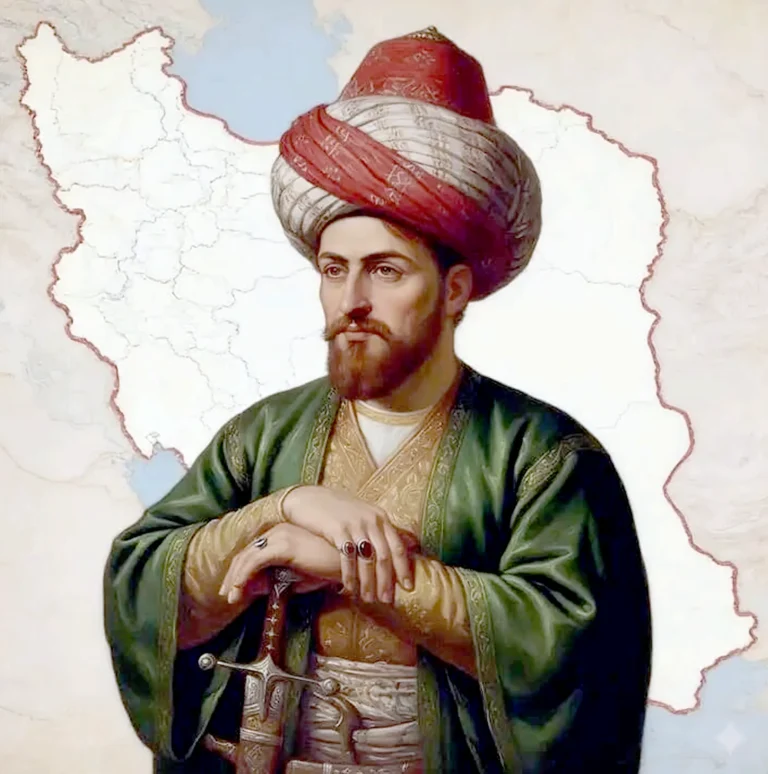
Tehran, Iran – Shah Ismail I, known as Ismail Safavi, is considered one of the most prominent leaders who left a profound mark on the history of the Middle East.
He founded the Safavid dynasty at the beginning of the 16th century,
unifying vast parts of Persia and making it one of the most powerful regional forces of the time.
He also engaged in a historic conflict with the Ottoman Empire that altered the balance of power in the region.
Ismail Safavi was born in 1487 into the Safavid family, which was associated with the Safavid Sufi order.
After his father’s death when he was young, he grew up in turbulent political circumstances.
At the age of fourteen, he successfully rallied his supporters and led
a military campaign that culminated in the capture of Tabriz in 1501,
where he declared himself Shah of Persia and established the Safavid dynasty.
Twelver Shi’ism is the official state religion
Ismail Safavi quickly expanded his state’s influence, gaining control over most of present-day Iran,
as well as parts of the Caucasus, Iraq, and Afghanistan,
establishing a powerful state that rivaled the great empires of the era.
One of his most significant decisions was declaring Twelver Shi’ism the official state religion,
a move that fundamentally transformed Iran’s religious identity and whose effects are still felt today.
This decision also contributed to shaping the political and sectarian balance in the region.
The Safavid expansion led to direct conflict with the Ottoman Empire,
which was itself undergoing a period of significant expansion under Sultan Selim I.
In 1514, the two sides fought the Battle of Chaldiran, which ended in
an Ottoman victory thanks to their superior use of artillery and firearms.
The Safavid forces suffered heavy losses, but this did not lead to the collapse of the state.
He redrawn the political and religious map of Persia
Despite this defeat, Ismail Safavi maintained the cohesion of his state and continued to govern until his death in 1524,
leaving behind a powerful empire that lasted for more than two centuries.
Under his successors, the empire witnessed political, cultural, and architectural flourishing, particularly in the city of Isfahan.
Historians consider Ismail Safavi not merely a military leader, but the founder of a state
that reshaped the political and religious landscape of Persia and contributed to the formation of modern Iranian identity.
The Safavid-Ottoman conflict remained one of the most prominent chapters in Islamic history for centuries,
due to its far-reaching political and military consequences across the region.