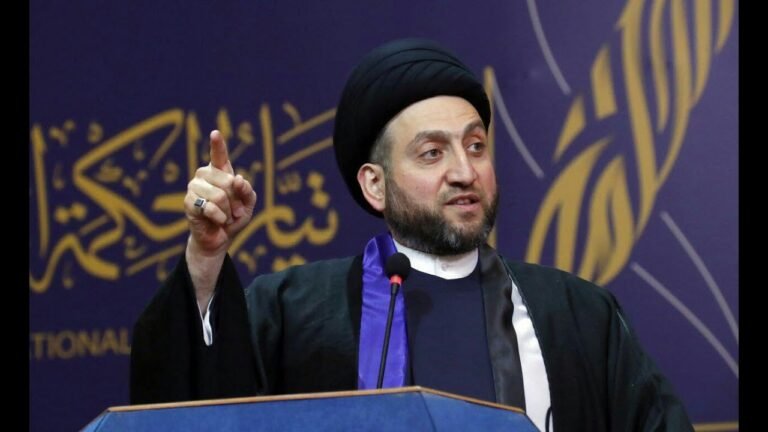
Baghdad, Iraq – On Tuesday, Ammar al-Hakim, head of the National Wisdom Movement in Iraq, revealed a clear and well-defined government plan aimed at completely consolidating weapons under state control. He indicated that this step is in full agreement and harmony with the provisions of the approved government program for strengthening internal security and stability.
Al-Hakim explained in official statements carried by Iraqi media that the armed factions are awaiting the arrival of September, the scheduled date for the withdrawal of international coalition forces from the country. This will allow them and other relevant parties to resolve this complex issue definitively, within the framework of shared national understandings and ongoing political processes aimed at establishing the rule of law.
The “Asa’ib Ahl al-Haq” movement begins disengaging its formations
In parallel with this high-level political effort to stabilize the security situation, the leadership of the Asa’ib Ahl al-Haq movement in Iraq decided on Tuesday to immediately implement a similar decision to sever ties with its armed factions. To this end, it issued an official order to form a specialized central committee authorized to undertake this complex organizational task.
According to an official statement published by the movement on its “X” platform, the newly formed committee will be responsible for completing all administrative, legal, and procedural requirements for implementing this pivotal decision. This includes conducting a complete and accurate inventory of all personnel, weapons, vehicles, equipment, and logistical resources, and establishing a direct link with the Commander-in-Chief of the Armed Forces. This is fully consistent with the requirements of the state and its official security and constitutional institutions.
A series of steps that place arms regulation at the forefront of priorities
The decision by the Asa’ib Ahl al-Haq movement comes just a week after the surprise move by the leader of the Shiite nationalist movement, Muqtada al-Sadr, to sever the Saraya al-Salam faction’s ties with his movement and fully integrate it into the official state security institutions. This has contributed to pushing the issue of disarming militias to the forefront of the current Iraqi political landscape.
For years, successive Iraqi governments have faced persistent internal and external pressure to consolidate all weapons under state control to ensure sovereignty. Despite these challenges, however, these groups have maintained, and continue to maintain, official legal cover for their weapons, and their members receive regular and direct salaries and financial allowances from the Iraqi state budget. This makes the current steps a significant strategic shift.