Babylon, Iraq – The anniversary of the death of Alexander the Great, one of history’s greatest military leaders, is being commemorated.
In just a few years, he established an empire that stretched from Greece in
the west to the borders of India in the east, thus changing the map of the ancient world.
He also left a political, military, and cultural legacy that has remained influential for centuries.
Alexander the Great was born in 356 BC in Pella, Macedonia, the son of King Philip II.
He was educated by the renowned philosopher Aristotle, who played
a significant role in shaping his intellectual and political character.
After his father’s assassination, he ascended to the throne at the age of twenty.
He then embarked on a series of military campaigns that cemented his place among history’s most famous leaders.
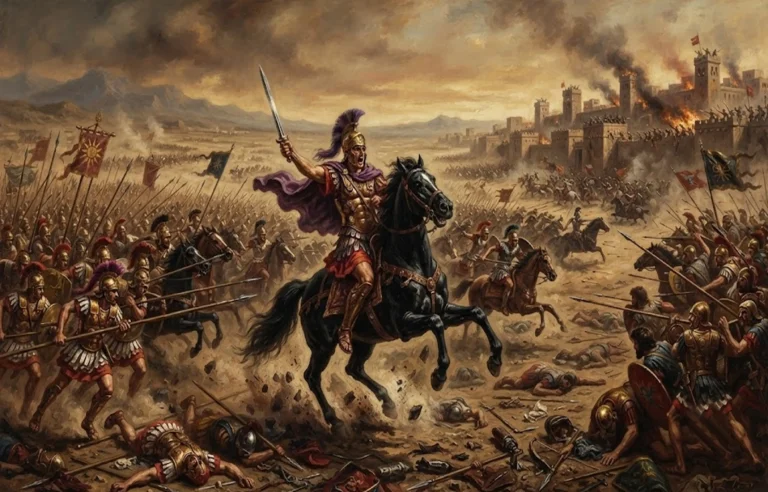
He achieved successive victories in decisive battles
Alexander began his great campaign against the Persian Empire,
achieving successive victories in decisive battles,
most notably the Battle of Issus and the Battle of Gaugamela.
He then entered Egypt, where he founded the city of Alexandria,
which later became one of the most important scientific and cultural centers in the ancient world.
His conquests did not stop at Persia; he continued his advance into Central Asia and reached the Indus River in India.
In doing so, he built a vast empire, the likes of which the ancient world had never seen.
These conquests also contributed to the spread of Greek culture and its integration with Eastern civilizations.
This formed what later became known as the Hellenistic period.
Historical controversy surrounding the causes of Alexander the Great’s death
In 323 BC, Alexander the Great died in Babylon at the age of 32, amidst ongoing historical debate about the cause of his death.
Some historians suggest he succumbed to a sudden illness, while others believe he was poisoned, though no conclusive evidence exists.
His sudden death led to the rapid disintegration of his empire, as his senior generals engaged in power struggles.
These conflicts ultimately resulted in the empire’s division into several independent kingdoms, most notably the Ptolemaic Kingdom in Egypt and the Seleucid Empire in Asia.
Despite his short reign, Alexander the Great remains one of the most influential figures in history.
His military campaigns shifted the balance of power in the ancient world and facilitated the exchange of knowledge, art, language, and culture between East and West.
For this reason, his life story continues to be a symbol of military ambition and exceptional leadership to this day.