
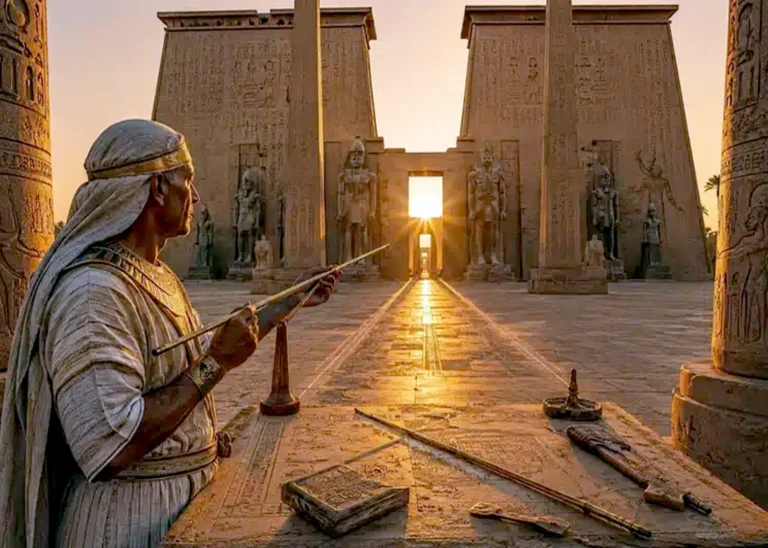
Cairo, Egypt – The phenomenon of the sun’s rays aligning with several ancient Egyptian temples is once again revealing aspects of the astronomical and engineering knowledge possessed by the ancient Egyptians.
It also demonstrates their ability to connect architecture with the sun’s movement and cycles throughout the year.
The alignment of the sun with the Abu Simbel temple is one of the most famous astronomical phenomena in Egypt.
At a specific time, the sun’s rays penetrate the inner sanctuary, illuminating the statues within the temple.
This spectacle reflects the precision of the design and the engineering calculations related to the temple’s location and orientation.
Determining times and seasons
The phenomenon is not limited to Abu Simbel; other archaeological sites in Egypt
are linked to the movement of the sun and the times of its rising and setting.
These include temples in Fayoum and the New Valley.
This highlights the connection between the design of religious structures
and the astronomical calculations upon which the ancient Egyptians relied to determine times and seasons.
This focus on the sun’s position indicates that astronomy was not a science separate from daily life in ancient Egypt.
Rather, it was intertwined with agriculture, the calendar, religious rituals, and the determination of important occasions.
The ingenuity of the ancient Egyptian architect
These phenomena also reveal the ingenuity of ancient Egyptian architects in accurately determining axes and directions.
Furthermore, they utilized the movement of celestial bodies in the design of their temples.
Thus, some of these sites became akin to open astronomical systems,
intertwined with both architecture and religious beliefs.
The phenomenon of the sun’s alignment with Egyptian temples remains
one of the most compelling pieces of evidence of the ancient Egyptians’ scientific advancements.
It also offers modern visitors a chance to reflect on a civilization that harnessed astronomical
and engineering knowledge to construct monuments that continue to inspire awe worldwide thousands of years later.