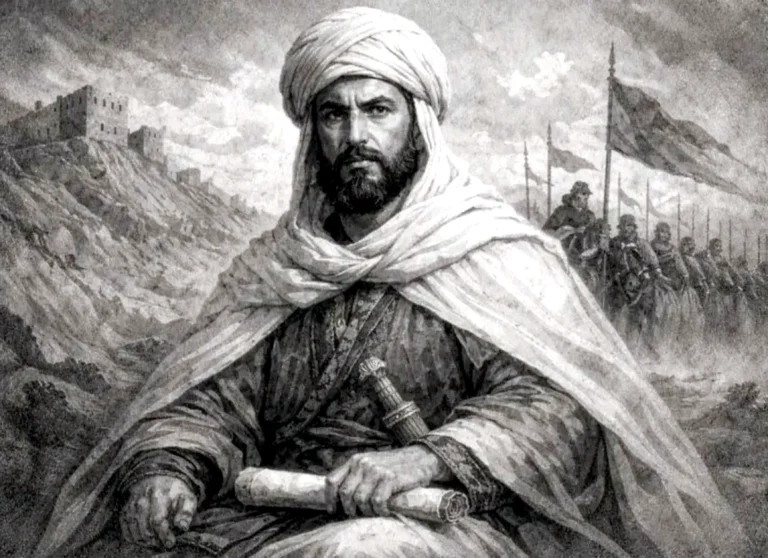
Tinmel, Morocco – The anniversary of the death of Muhammad ibn Tumart, founder of the Almohad movement, which later became one of the most prominent political forces in the Maghreb and Andalusia
during the 6th century AH (12th century CE), is being commemorated.
This period was marked by profound conflicts and transformations across the region.
Ibn Tumart was born in the Souss region of Morocco and raised in a scholarly and religious environment.
He then traveled to the East in pursuit of knowledge, where he received religious instruction before returning to Morocco.
Following his return, he embarked on a broad reformist and intellectual movement.
An intellectual and political confrontation with the Almoravids
Upon his return, he engaged in intellectual and political conflict with the Almoravids,
criticizing several practices he considered contrary to the true teachings of Islam.
He subsequently gained followers and supporters, and founded a movement known as the Almohads.
Ibn Tumart chose the Tinmel region in the Atlas Mountains as the center of his activities,
from which he began organizing the movement and expanding its influence.
He also benefited from the support he garnered among several tribes.
Although Ibn Tumart died before completing his political project,
his successor, Abd al-Mu’min ibn Ali, continued the movement
and succeeded in building a powerful state that ended Almoravid rule.
The Almohad influence then extended over vast areas of Morocco and Andalusia.
An influential political and military force
The Almohad state later transformed into a powerful political and military force in the western Islamic world.
Its reign also witnessed a flourishing of scientific, intellectual,
and architectural activity that left its mark on the history of Morocco and Andalusia.
The figure of Ibn Tumart remains of great interest to historians, as he was the architect of a religious
and political project that established a movement whose influence extended far beyond his lifetime.
Within a few decades, it had transformed into a state with considerable influence in Morocco and Andalusia.