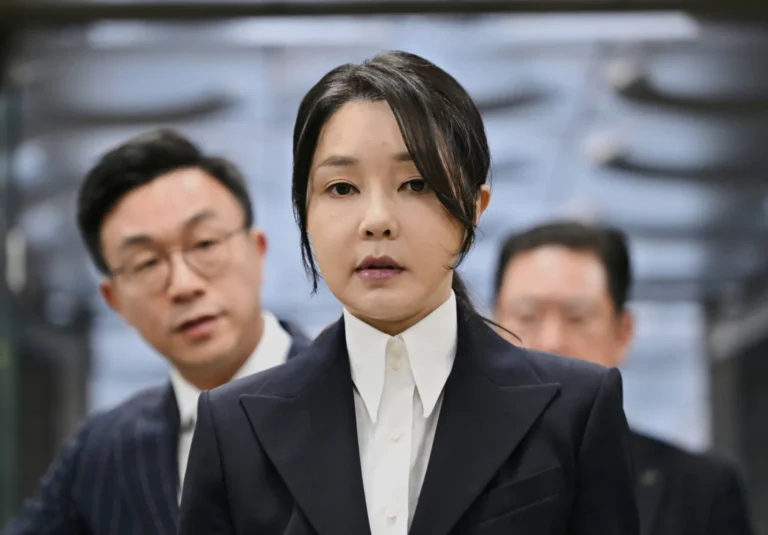
Seoul, South Korea – The Seoul Central District Court sentenced former South Korean First Lady Kim Kyung-hee to seven years in prison on Friday. She was convicted of corruption and accepting lavish bribes in exchange for political favors and benefits.
Details of the conviction and charges
The court ruling followed a series of investigations that revealed the involvement of Kim Yo-jong, the wife of former President Yoon Sok-yol. Yoon was impeached in 2015 for attempting to impose martial law.
The judge stated in his ruling that Kim Yo-jong abused her position as First Lady to interfere in government appointments and grant business favors. He also noted that she was “willing to use her power” to secure high-ranking political positions or economic advantages for individuals in exchange for expensive gifts.
List of luxury bribes
The investigation revealed a long list of gifts Kim received. The court stated that this list “reflects the extent of the illicit infiltration of state institutions.” The list of bribes included a Van Cleef & Arpels necklace, a Tiffany brooch, and Graff earrings. It also included a gold tortoise, a Dior handbag, and a Vacheron Constantin watch valued at approximately 39 million won (around $25,000). In addition, there was a painting valued at 140 million won.
Financial penalties and the defense position
In addition to the prison sentence, the court imposed a fine of 64.8 million won on Kim. The court also issued a court order to confiscate all gifts and items deemed to be part of the bribery scheme.
For her part, Kim Kyun-hee categorically denied all charges against her during the trial.
Her defense team confirmed to reporters after the verdict that they intend to appeal the decision to higher courts. They argued that the judge “expanded his interpretation of the evidence” and was biased against their client.
This ruling marks a significant legal and political development in South Korea. Its importance stems from the ongoing political crisis that has gripped the country since the impeachment of President Yoon Suk-yeol. It also reflects the South Korean judiciary’s determination to prosecute and hold accountable figures from the previous regime for any abuse of power or manipulation of state resources.