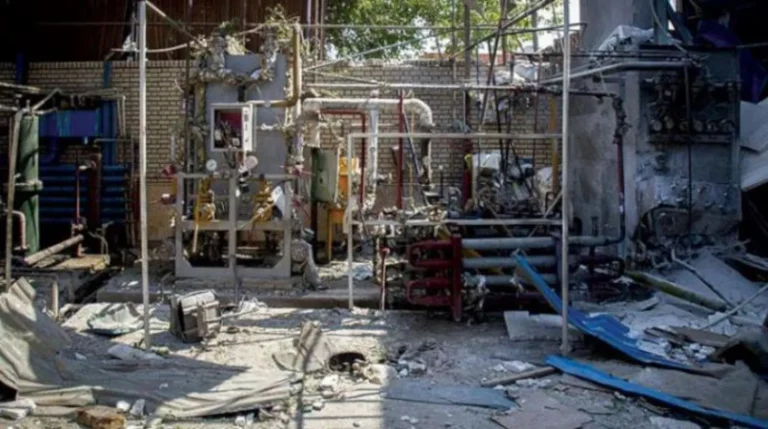
Tehran, Iran – In an official acknowledgment reflecting the extent of the damage inflicted on Iran’s infrastructure during the 39-day war, Deputy Minister of Electricity and Energy, Mostafa Rajabi Mashhadi, announced that approximately 7,000 megawatts of the country’s power generation capacity had suffered varying degrees of damage as a result of the recent military operations.
Details of the damage in the energy sector
Rajabi Mashhadi explained that the damage affected the entire aforementioned production capacity. He stated that approximately 4,500 megawatts of it sustained severe damage, resulting in its complete shutdown for extended periods.
In an effort to contain the crisis, the Iranian official confirmed that the technical teams’ efforts have thus far resulted in reconnecting 2,500 megawatts to the national grid. He indicated that work is proceeding rapidly to rebuild and repair the remaining power plants. This aims to ensure the stability of the electricity supply, which is facing immense pressure.
Conflicting official statements regarding the extent of the losses
This announcement comes amid confusion in official Iranian discourse, with conflicting statements from high-ranking officials regarding the true extent of the losses in the electricity sector. While Rajabi Mashhadi cited figures as high as 7,000 megawatts, the energy minister had earlier announced on Friday that the total damage amounted to only about 4,200 megawatts.
Reports indicate that the affected facilities were primarily located in vital and strategic locations within the steel and petrochemical sectors. This was particularly evident in the Isfahan, Mahshahr, and Asaluyeh regions of southwestern Iran.
These areas are the economic heart of the country. Therefore, targeting them represents a significant blow not only to the energy sector but also to heavy industries and exports.
Reconstruction challenges
This discrepancy in official estimates raises questions about the accuracy of the data provided by the Iranian government regarding the impact of the ongoing war, now in its sixth month. While efforts to repair damaged power plants continue, Iran faces significant logistical and technical challenges in securing spare parts and the necessary funding to rehabilitate critical infrastructure. This is particularly concerning given the country’s international isolation and escalating economic pressures. The future of Iran’s energy sector remains contingent on the speed of these repairs, while the Iranian public anxiously awaits the repercussions of these crises on the continuity of essential services.