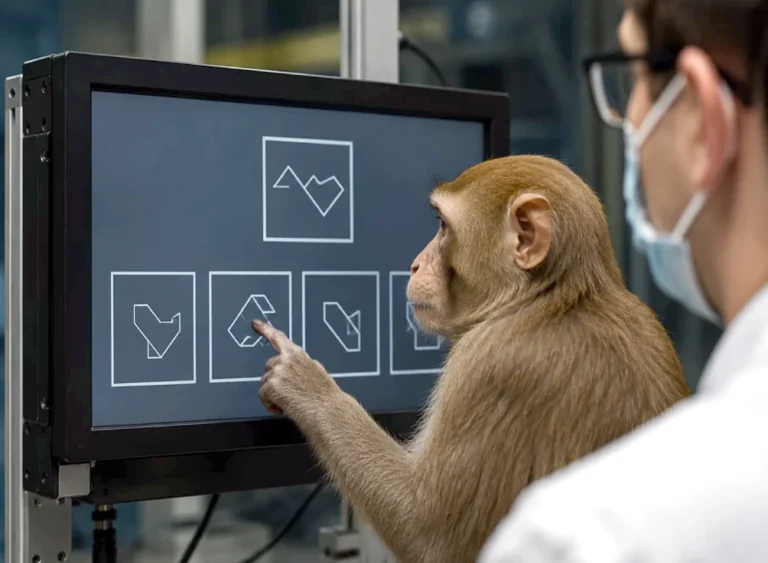
Oxford, UK – A recent scientific study has revealed that some monkey species possess spatial reasoning and construction abilities that resemble the basic principles of geometry used by humans. This discovery highlights a sophisticated level of spatial awareness in primates.
Development of cognitive abilities
The researchers explained that the experiments demonstrated the monkeys’ ability to select and arrange shapes in a way that achieves stability and balance when constructing simple structures.
This suggests they possess an innate understanding of certain concepts related to geometry and physics, rather than relying solely on trial and error.
The study involved observing the behavior of several monkeys as they performed tasks requiring the assembly of different pieces or the use of tools to achieve specific goals.
The scientists noted that the animals chose more efficient and stable solutions with repeated trials, reflecting an evolution in their cognitive abilities.
Cognitive convergence between humans and primates
The researchers pointed out that the findings do not mean that monkeys practice engineering in the human sense.
However, they reveal that monkeys possess mental mechanisms that help them understand spatial relationships, balance, and structural design.
These are skills believed to have formed the basis for the development of human engineering abilities over thousands of years.
Animal behaviorists believe this discovery adds further evidence to the cognitive convergence between humans and primates.
It also opens the door to further studies to understand the evolution of intelligence and shared mental abilities across species.
The researchers emphasize that the study’s findings could contribute to advancements in research related to brain development and cognition in living organisms.
Furthermore, they may help in understanding the early stages that preceded the emergence of the complex engineering skills that characterize modern humans.