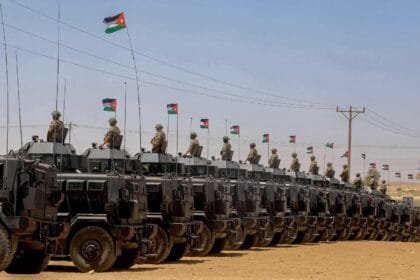
Amman – Jordan — The Hashemite Kingdom of Jordan has officially announced the inauguration and operationalization of new, state-of-the-art military facilities. This deployment is part of its ongoing strategic blueprints to reinforce land border security and elevate the efficiency of tactical monitoring and rapid-response operations. In addition, it frames a comprehensive and expanded national effort to counter organized smuggling and unauthorized infiltrations across highly sensitive border sectors.
Intelligent Surveillance Matrix and Round-the-Clock Detection Tech
Official Jordanian briefers stated that these newly commissioned facilities are an engineered component of a macro-level modernization plan targeting the state’s military infrastructure. The primary objective centers on upgrading and expanding the logistical and field capabilities of the Jordanian Armed Forces (The Arab Army). Moreover, the plan aims to monitor and fortify extended borders with neighboring countries. It heavily relies on next-generation tech and advanced digital detection architectures functioning 24/7.
These specialized military installations house integrated field command-and-control centers, operating in tandem with advanced forward reconnaissance outposts. These stations are outfitted with cutting-edge wireless communication suites, long-range thermal imaging networks, and high-precision ground sensors. The sensors can track and isolate suspicious movements across arid desert expanses and rugged terrains. Notably, these geographies have historically been classified as the most logistically challenging environments for military perimeter containment.
Countering Sophisticated Smuggling Synicates and Security Interoperability
Authoritative agencies verified that this strategic deployment materializes against a backdrop of compounding security challenges tied to systemic, highly organized smuggling operations, particularly along the Kingdom’s northern and eastern borders. Illicit smuggling syndicates have increasingly scaled their operational parameters by adopting sophisticated, tech-reliant concealment methods, creating an absolute necessity for continuous, parallel counter-advancements in defense tools, tactical intercept mechanisms, and field intelligence frameworks. Furthermore, sources indicated that the Jordanian Armed Forces maintain aggressive intelligence and logistical interoperability with various domestic security apparatuses to guarantee the highest matrix of cross-departmental integration, ultimately shielding national sovereignty and preempting threats to internal stability.
Defense analysts and military observers posit that upgrading border-theater military infrastructure showcases Amman’s institutional defense doctrine. This doctrine explicitly synthesizes advanced hardware with highly trained human assets. As a result, this formula dramatically compresses rapid-response timelines and scales tactical maneuverability. Furthermore, it systematically neutralizes latent asymmetrical threats before they cross national thresholds. These localized advancements emerge during an era of heightened regional geopolitical and security volatility. This situation renders border domain management a primary, high-stakes priority within contemporary regional defense frameworks—especially given the complex socio-economic and security intersections native to cross-border contraband pipelines. Through the activation of these advanced facilities, Jordan aggressively locks down its national defense architecture under a decisive doctrine. The doctrine is committed to protecting internal peace and guarding sovereign frontiers. At the same time, it fluidly absorbs modern technological evolutions within the global defense sector.