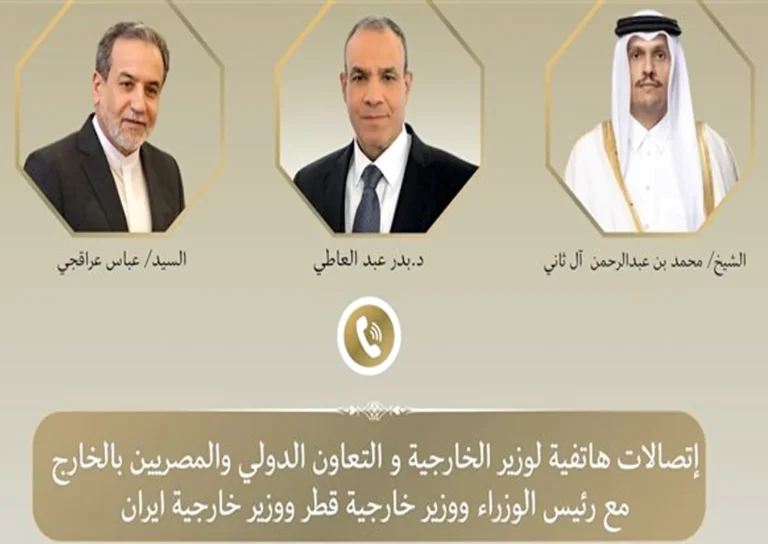
Cairo, Egypt – As part of Egypt’s pivotal role in strengthening the foundations of stability in the Middle East, Egyptian Foreign Minister Dr. Badr Abdel-Aty held extensive telephone conversations, including with Sheikh Mohammed bin Abdulrahman bin Jassim Al Thani, Prime Minister and Foreign Minister of Qatar, and Abbas Araqchi, the Iranian Foreign Minister. Discussions focused on ways to advance regional de-escalation. In addition, the latest developments in the negotiations between Washington and Tehran were discussed.
Diplomacy of de-escalation and conflict resolution
During his consultations with his Qatari and Iranian counterparts, Abdel-Aati stressed that the top priority at this stage lies in:
Prioritizing political solutions: Adhering to the diplomatic track as the only alternative for addressing complex crises.
Sustaining the ceasefire: He also emphasized the need to intensify coordination among the relevant parties to ensure the consolidation of the truce. This step aims to transform it into a permanent cessation of hostilities, ultimately leading to the end of the conflicts.
State sovereignty: the cornerstone of regional security
Dr. Abdel-Aati emphasized that serious dialogue is the only way to prevent the region from sliding into wider conflicts. He explained that Cairo’s vision for regional security is based on unwavering principles, the most important of which are:
Respect for national sovereignty: All parties must respect the sovereignty of states and refrain from interfering in their internal affairs.
Gulf security: He also stressed the need to address the security concerns of the region’s countries, particularly in the Arabian Gulf. This is considered an integral part of Arab national security.
Navigation security and global economic stability
Maritime security was also on the agenda, with Abdel-Aty noting that freedom of international navigation is not merely a regional issue, but a cornerstone of global economic stability. He called for continued joint efforts and international coordination to ensure the safety of waterways and protect them from any threats that could exacerbate tensions.
These contacts reflect Egypt’s consistent strategy of reducing polarization. They also aim to consolidate the foundations of comprehensive peace by building bridges of communication between regional and international powers in a way that serves the interests of the region’s peoples.