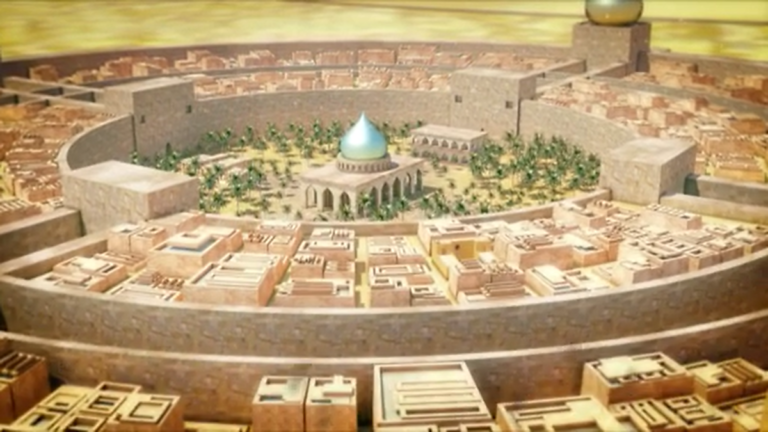
Baghdad – The shift of the center of gravity from Damascus to Baghdad with the establishment of the Abbasid State in 750 AD represented a major turning point that redrew the map of cultural and political influence in Islamic history. This change was not merely a transfer of power but the launch of a more inclusive vision that merged multiple cultures into a single fabric. Thanks to Caliph Abu Jaafar al-Mansur’s genius in selecting Baghdad’s location, the city quickly transformed into a global center for trade and science, opening a new chapter known as the “Golden Age,” where Islamic civilization was no longer just a military power but a comprehensive civilizational project that dazzled the world.
The “House of Wisdom” Revolution: How Al-Khwarizmi and Al-Razi Led the Knowledge Train from Baghdad to Europe?
This era witnessed an unprecedented scientific renaissance with the emergence of the “House of Wisdom” as a pioneering institution in the translation movement, where foundational books in medicine, philosophy, and mathematics were translated. Obviously, the brilliance of scholars like Al-Khwarizmi, Al-Razi, and Al-Kindi contributed to making Islamic civilization a true bridge for transferring and developing knowledge between East and West. As a result, trade flourished due to Baghdad’s strategic location on the Silk Roads, strengthening the state’s economic power and political influence, turning sciences and arts into a global language reflecting a unique state of intellectual diversity and openness.
A Lasting Legacy: The Abbasids Did Not Just Rule a State; They Founded a Cultural Identity for Humanity
Historians believe that the Abbasids succeeded in establishing a civilizational project that transcends time, reshaping the cultural identity of the Islamic world and leaving an indelible mark on human history. Accordingly, this era was characterized by the development of arts and schools of thought that accompanied the scientific renaissance, despite the political conflicts that occasionally surfaced. Ultimately, Abbasid Baghdad remains a symbol of the phase where words and science led the locomotive of history, proving that glory is not made through politics alone, but through cultural openness and building institutions that serve human knowledge to this day.