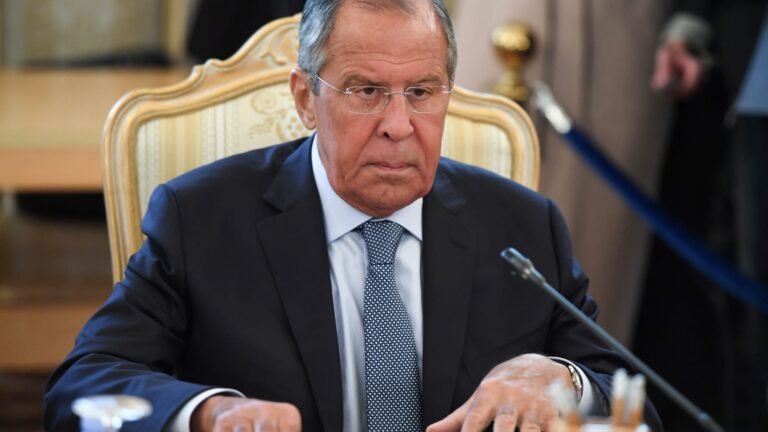
Moscow – Russian Foreign Minister Sergey Lavrov called on the United States to take serious and immediate action to calm escalating tensions in both the Strait of Hormuz and Ukraine, asserting that continued escalation in these two regions threatens international stability in an unprecedented manner. Lavrov explained that Moscow sees an urgent necessity to open “responsible” direct dialogue channels between major powers to avoid sliding toward a broader military confrontation, noting that the Gulf region is experiencing extreme sensitivity that could devastate global energy security, while the Ukrainian crisis remains a constant point of friction in international relations.
Energy Security and Navigation: Why Does Russia Fear the Hormuz Crisis Spiraling Out of Control?
Lavrov affirmed that his country is open to any genuine diplomatic initiatives for de-escalation, urging Washington to adopt a “balanced” approach that considers everyone’s interests rather than a policy of deepening divisions. Obviously, Russian concern stems from the close link between the shipping crisis in Hormuz and global oil prices, especially given reports indicating the complexity of the scene following recent airstrikes. As a result, observers believe Moscow is trying to play the role of a “safety valve” to ensure energy supplies are not affected at a time when the global economy is suffering from sharp inflationary pressures.
Washington Under the Microscope: Will the US Administration Respond to the “Direct Dialogue” Initiative?
So far, Washington has remained silent regarding the Russian call, amid international anticipation for any movement that might help cool down the active fronts. Accordingly, analysts believe the Russian call is a clever attempt to put the ball in the American court, portraying Moscow as a “peacemaker” seeking political solutions. Given the intertwining of economic and security crises, the diplomatic option remains the most urgent requirement to avoid catastrophic scenarios that could bloodily reshape the world order if direct negotiation channels continue to be ignored.