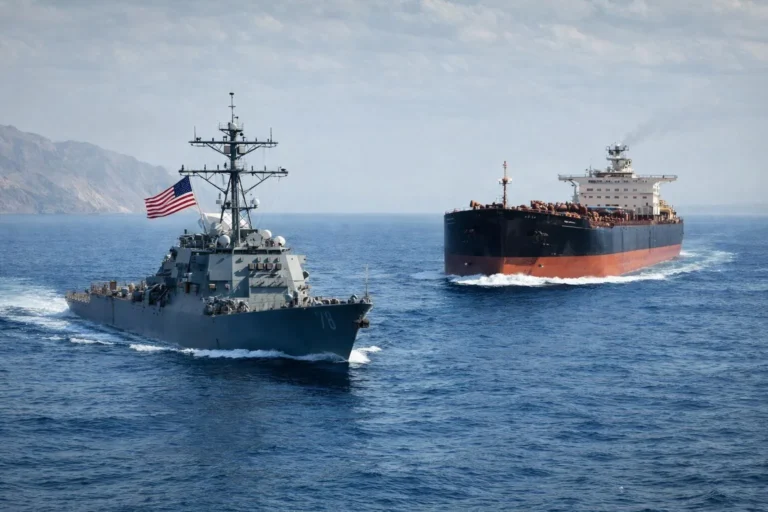
Washington, DC – In a development reflecting the United States’ firm resolve to cripple Iran’s economic resources, Reuters reported that a US Navy destroyer intercepted two oil tankers on Tuesday as they attempted to break the naval blockade and leave Iranian waters. The agency stated that the tankers were given strict orders to return immediately to their ports of origin.
The agency quoted a senior US official, speaking on condition of anonymity, as saying that the incident occurred in international waters near the Gulf of Oman. The official added that the two tankers had departed from the strategic port of Chabahar on the Indian Ocean. Before being detected by US radar, the US Navy had been tracking their movements.
As soon as the warship approached the location, contact was made with the tankers’ crews via radio. Clear military orders were then issued prohibiting them from continuing their voyage and instructing them to turn around and return to Iranian waters. The ships complied with the orders to avoid a direct military confrontation.
For its part, the US Central Command (CENTCOM) confirmed in an official statement that the current blockade of the Strait of Hormuz and Iranian maritime routes is being enforced “impartially against the vessels of all nations.” This indicates that Washington will not allow any international party to violate these punitive measures.
CENTCOM added in a post on its X platform that US Navy guided-missile destroyers are the cornerstone of this blockade. It also noted that these warships have highly trained professional crews of over 300 personnel each. These destroyers operate around the clock to ensure the complete closure of maritime routes.
These developments on the ground come after the US military announced a comprehensive naval blockade that began last Monday. This is seen as a maximum pressure tactic to force Tehran to accept the “grand bargain” proposed by President Donald Trump.
With Washington confirming its refusal to extend the temporary truce scheduled for April 8, observers believe that the interception of ships at the port of Chabahar sends a clear message. It indicates that the blockade is not limited to the Strait of Hormuz but extends to all of Iran’s open coastlines. This effectively paralyzes the Iranian economy, leaving it to await further developments.