Dubai, UAE – Dubai Electricity and Water Authority continues to consolidate its role in supporting local and global efforts to protect the environment. Through an integrated system of projects and initiatives that contribute to reducing carbon emissions and increasing resource efficiency. Accelerating the transition towards clean energy and a green economy, in line with the vision of the wise leadership and the UAE’s efforts in climate action.
These efforts coincide with the celebration of World Environment Day, which falls on June 5 of each year.
This year’s event is organized under the theme “Action for Climate Today,” which emphasizes that environmental protection is a strategic imperative closely linked to future development. And quality of life, in addition to preserving natural resources for future generations.
commitment to sustainability
The Authority implements a range of qualitative projects and initiatives that reflect its firm commitment to making environmental sustainability an integral part of its institutional and operational model. It contributes to supporting the goals of the Dubai Clean Energy Strategy 2050 and the Carbon Neutrality Strategy 2050 of the Emirate of Dubai. With the aim of providing 100% of energy production capacity from clean sources by 2050.
The Mohammed bin Rashid Al Maktoum Solar Park, implemented by the Authority, is the largest single-site solar energy project in the world with an independent energy producer system. With a production capacity that will exceed 8,000 megawatts by 2030, its current capacity is 3,860 megawatts, using the latest solar photovoltaic and concentrated solar power technologies.
The proportion of clean energy in Dubai’s energy mix is expected to rise to 36% by 2030, compared to 25% in the original plan. This contributes to reducing more than 8.5 million tons of carbon emissions annually.
Green Hydrogen Project
The “Green Hydrogen” project is the first of its kind in the Middle East and North Africa region to produce hydrogen using solar energy. And store it and convert it back into electrical energy, among other uses.
The project produces about 20 kilograms of hydrogen per hour, while the storage tank can hold up to 240 kilograms. The station uses hydrogen via an engine with a capacity of approximately 300 kilowatts to produce electricity, and was designed to be a flexible platform for testing future applications for various uses of hydrogen.
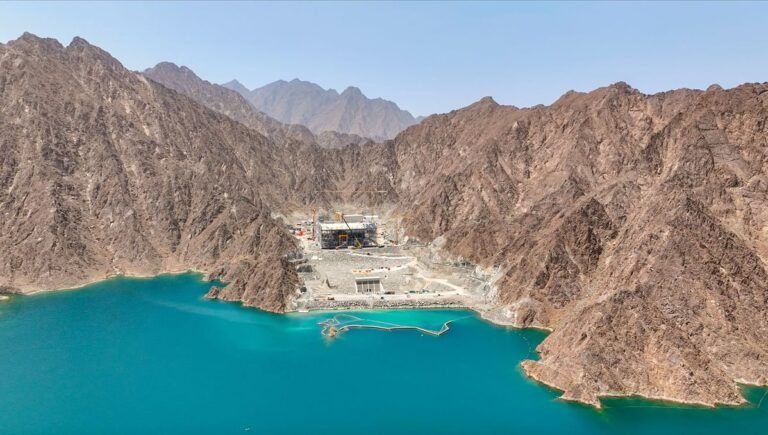
The hydroelectric station with stored hydropower technology in Hatta is the first of its kind in the Gulf Cooperation Council countries, with a capacity of 250 megawatts. Its storage capacity will reach 1,500 megawatt hours, with a lifespan of up to 80 years.
Green Charger Initiative
The Authority launched the “Green Charger” initiative in 2014 to establish an integrated infrastructure for electric vehicle charging stations. Supporting green mobility and contributing to Dubai’s vision of being the smartest and happiest city in the world.
The network of electric vehicle charging stations currently includes more than 2,223 charging points across Dubai. In cooperation with the Authority’s partners.
The Authority allows all customers, whether registered in the “Green Charger” initiative or not, to benefit from the service through the “Visitor Feature”. Dealers can locate stations through the Authority’s smart application or website, or through 14 other digital platforms.
The Authority is committed to applying the highest local and international standards for environmentally friendly buildings in all its facilities, with a focus on enhancing the efficiency of resource use such as energy and water. Over its entire life cycle, it currently has 10 green buildings that have been awarded the Leadership in Energy and Environmental Design (LEED) rating.
Smart government building
The “Sail Building”, the Authority’s new headquarters, was constructed as the tallest, largest and smartest government building in the world, while achieving energy positivity. It was designed to meet the requirements for obtaining a platinum rating according to the “Leadership in Energy and Environmental Design” (LEED) system, in addition to the “WELL” gold certificate for sanitary buildings.
The building relies on an advanced technical system that includes the Internet of Things, big data analysis, and artificial intelligence. Along with the latest renewable energy solutions.