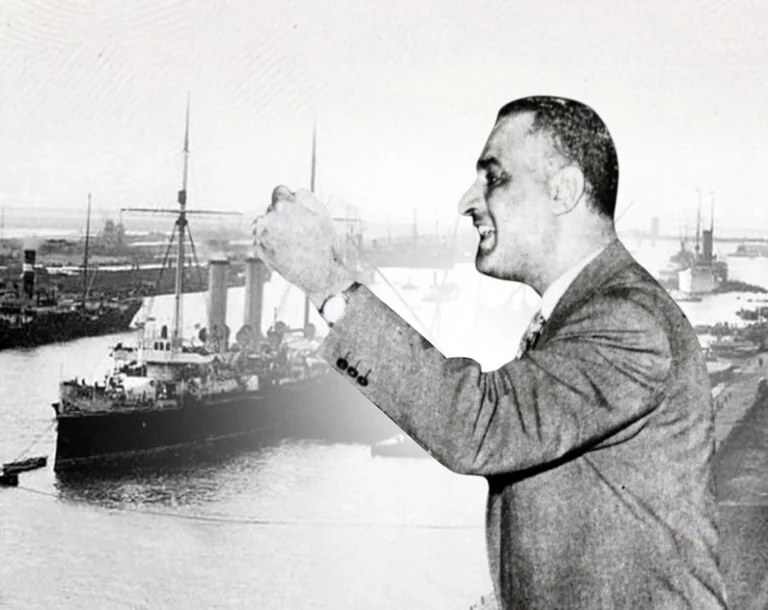
Cairo, Egypt – The nationalization of the Suez Canal, announced by the late Egyptian President Gamal Abdel Nasser on July 26, 1956, is considered one of the most pivotal events in the history of the modern Middle East.
It was not merely an economic decision concerning the management of a global waterway,
but rather a move that escalated into an international crisis culminating
in the Tripartite Aggression against Egypt, and reshaped the balance of power in the region and the world.
Historians believe that nationalization marked a turning point in
the trajectory of national liberation movements, solidified Egypt’s position
as an influential regional power, and represented the beginning of the decline of traditional colonial influence in the Middle East.
Why did Egypt make the decision to nationalize?
The nationalization decision came after the United States, Britain,
and the World Bank announced the withdrawal of funding for the Aswan High Dam project,
a move Cairo considered an attempt to exert political pressure on Egypt.
In response, President Gamal Abdel Nasser announced the nationalization of the Suez Canal Company,
asserting that the canal’s revenues would be used to finance the construction of the Aswan High Dam,
which he deemed a strategic project for national development.
The decision angered Britain and France, which had significant economic and political interests in the canal
and viewed nationalization as a direct threat to their influence in the region.
Meanwhile, Israel perceived Egypt’s growing power as a threat to its security,
leading to secret consultations among the three countries that culminated in
a joint military plan to regain control of the canal and weaken the Egyptian leadership.
The tripartite aggression… and international pressure ended the war
In late October 1956, Israel launched an attack on the Sinai Peninsula,
followed by British and French military intervention under the pretext of protecting international navigation in the Suez Canal.
The canal cities, especially Port Said, witnessed violent battles and widespread popular resistance,
while Egyptian sites were subjected to intense bombardment during military operations.
Despite the military superiority of the attacking forces, international pressure,
especially from the United States and the Soviet Union,
along with United Nations movements, forced Britain, France,
and Israel to stop military operations and withdraw from Egyptian territory.
This development constituted a major shift in the international system,
as it revealed the decline in the ability of the European colonial powers
to impose their will alone, in light of the emergence of the United States and the Soviet Union as two superpowers.
Results and events that changed the region and history
Egypt’s success in retaining control of the Suez Canal bolstered
President Gamal Abdel Nasser’s standing both regionally and internationally.
It also gave a significant boost to national liberation movements in Asia and Africa,
encouraging several countries to demand independence and an end to colonial rule.
The Suez Canal came under complete Egyptian administration
and became one of the most important sources of national income,
in addition to continuing its role as a strategic waterway connecting the Red Sea and the Mediterranean.
The nationalization of the Suez Canal is still considered one of the most
important political decisions of the 20th century, as its impact extended beyond Egypt’s borders,
reshaping the balance of power in the Middle East and underscoring
the ability of sovereign decisions to effect major transformations in international relations.
Decades after that crisis, the Suez Canal remains a symbol of national sovereignty
and one of the most important maritime routes influencing global trade and the international economy.