Berlin, Germany – The German Confederation stands as one of the most significant political entities that altered the course of European history. It acted as the bridge between centuries of political fragmentation—where German lands were split among dozens of independent kingdoms and principalities. Additionally, it was the dawn of a unified German state. This entity served as the primary laboratory for forging a shared German national consciousness.
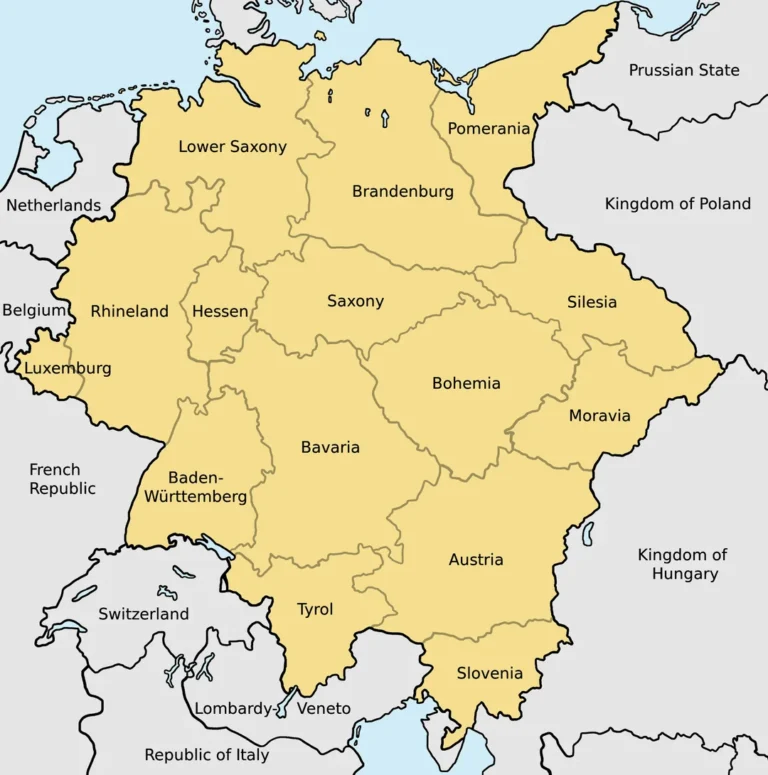
Established in 1815, in the aftermath of the Napoleonic Wars and the historic “Congress of Vienna,” the Confederation’s goal was to redraw Europe’s political map and create a delicate balance of power. Initially, the German Confederation included dozens of German-speaking states and kingdoms under a common political umbrella. Yet, it maintained their internal independence. This created a flexible framework for political cooperation and collective defense.
The First Seed of National Unity
In a related context, the Confederation was not a unified state in the traditional sense; rather, it was a confederate framework that provided an institutional structure for coordination. Despite its limited central powers, it played a vital role in developing economic and political ties among its members. Over time, nationalistic ideals permeated the social fabric. As a result, German peoples began to aspire toward a more powerful, unified entity.
Furthermore, the second half of the 19th century witnessed dramatic transformations. The Kingdom of Prussia’s economic and military influence grew, making it the driving force toward total unification. Following the Austro-Prussian War of 1866, the German Confederation, in its traditional form, came to an end. This paved the way for the “North German Confederation,” which served as the final operational step before the major declaration.
From the Palace of Versailles to a Great Power
On another note, these efforts culminated in the official proclamation of the German Empire in 1871 at the Palace of Versailles in France. This achieved the first comprehensive political unification of German territories in the modern era. As a result, Germany transformed from a scattering of principalities into one of the most influential international powers.
In conclusion, historians today agree that the German Confederation, despite the challenges it faced and the difficulties in coordinating among its members, was the indispensable seed in Germany’s history. It succeeded in melting local identities into a single national identity and established the political and economic conditions that paved the way for modern Germany, remaining an unskippable link in understanding the birth of the contemporary German state.