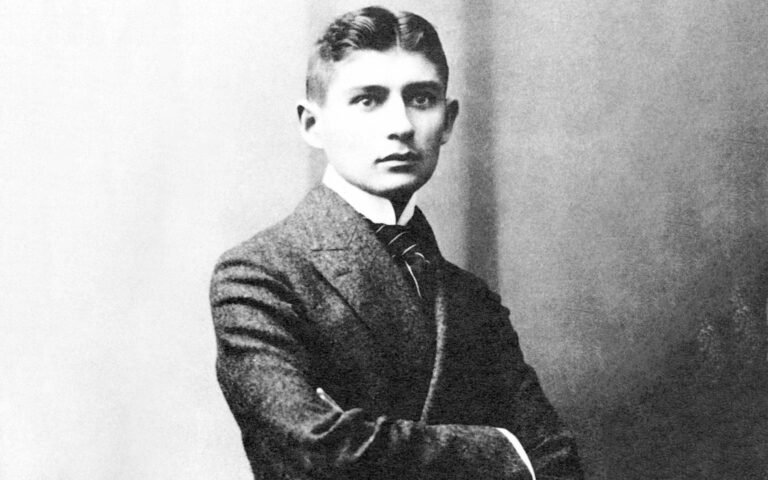
Bogota – Colombia — The global literary community marks the passing of the renowned Czech author Franz Kafka, one of the most strategic and foundational names to carve a profound, structural legacy into 20th-century world literature. Kafka’s works and manuscripts continue to command immense analytical attention and scholarly research among readers, academics, and critics alike, while his intellectual and narrative influence cascades continuously into successive generations of novelists and creatives globally.
The Triad of Absurdity, Human Anxiety, and the Milestone of Transformation
Kafka, who passed away on June 3, 1924, at the young age of forty, is widely heralded as one of the most influential modernist writers to reshape the orbit of the modern novel and dismantle its classical frameworks. This is credited to a unique literary output that masterfully fused meticulous realism, absurdist philosophy, and raw human existential dread. Headlining these immortal narrative monuments are his masterworks The Trial, The Castle, and short fiction gems like The Metamorphosis.
Among the premier global literary icons deeply altered by the Kafkaesque school is the celebrated Colombian novelist and Nobel Laureate in Literature, Gabriel García Márquez. Márquez spoke expansively across multiple interviews and memoirs regarding the shocking, illuminative moment he first discovered the Czech writer’s prose, categorizing it as a definitive and pivotal watershed moment in sculpting his own literary trajectory and artistic consciousness.
The Kafkaesque Insect That Liberated Márquez’s Pen from Traditional Logic
According to his testimonies, Márquez asserted that his inaugural reading of the iconic opening line of The Metamorphosis—in which the protagonist, Gregor Samsa, awakens abruptly on his bed to find himself transformed into a monstrous, grotesque insect—made him realize in a fleeting flash of clarity that true literature is never bound by rigid academic constraints or conventional mathematical logic. He understood that a gifted storyteller possesses the absolute liberty to engineer a highly fantastical universe and persuade the reader of its surreal details, provided they hold the innate talent and narrative prowess to anchor the prose.
The late Colombian novelist noted that this early, jarring reading unbolted unexplored imaginative vistas for his writing, directly participating in refining and crystallizing his unique narrative outlook. This exact realization later propelled him to draft and pioneer his internationally acclaimed novelistic style known as “Magical Realism,” which materialized beautifully in the composition of literary masterpieces that achieved global fame, such as One Hundred Years of Solitude and Love in the Time of Cholera.
The ‘Kafkaesque’ as a Universal Paradigm and Everlasting Critical Resonance
In this context, literary critics and narrative theorists argue that the cross-continental Kafkaesque effect was never restricted to Márquez’s isolated experience; rather, it permeated the output of a vast spectrum of novelists across all five continents. The term “Kafkaesque” has graduated into an accredited global literary and political paradigm utilized to articulate absurdist scenarios, dark and complex bureaucratic labyrinths, and the paralyzing sense of isolation and crushing helplessness an individual faces when pitted against faceless, looming, and invisible mechanisms of power.
Although Franz Kafka never tasted global fame or critical vindication throughout his brief life, which was shadowed by psychological friction, his legacy—rescued and published posthumously by his loyal confidant Max Brod—swiftly morphed into a structural cornerstone of world heritage. Today, his texts serve as core curricula in leading international universities and are translated into dozens of living languages, while his creative ghost continues to influence cinema, theater, visual arts, and modern human philosophy. Over a century following his physical departure, Franz Kafka continues to fortify his dominant presence in the global cultural arena as the definitive prophet of modern human fragmentation and deep existential inquiry, while the testimonies of literary giants like Márquez remain an unshakeable testament to the strategic depth he left behind in the currents of human storytelling.