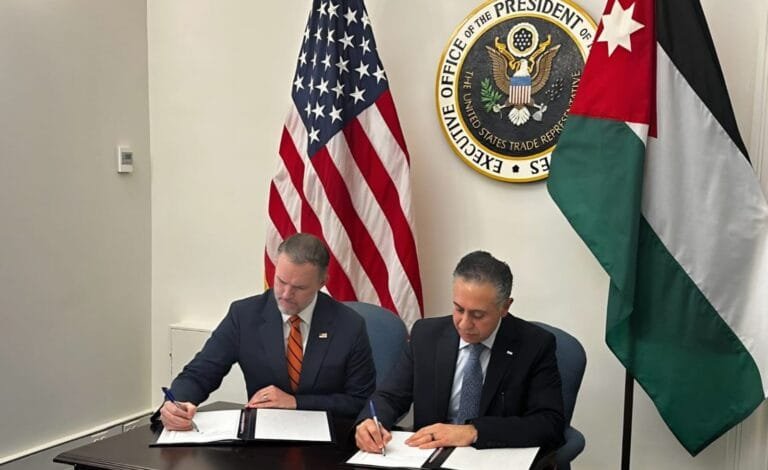
Amman, Jordan – Jordan and the United States have officially signed a landmark Agreement on Reciprocal Trade, marking a strategic initiative designed to deepen economic integration, eliminate market barriers, and expand bilateral investment between the two nations.
Core Objectives and Trade Facilitation
The agreement was signed by Jordan’s Minister of Industry, Trade, and Supply, Yarub Qudah, and United States Trade Representative Jamieson Greer. The pact establishes duty-free market access for nearly all traded goods, targets the removal of non-tariff barriers, and streamlines customs clearance procedures. It also creates frameworks for digital trade and service sector cooperation without discriminatory tariffs.
Under the agreement, both parties committed to enforcing rigorous environmental standards, protecting labor rights—including prohibiting imports produced via forced labor—and bolstering intellectual property protections to cultivate a fair, transparent business environment.
Strategic Investments and Supply Chain Alignment
In addition to trade facilitation, the framework enhances supply chain resilience and establishes joint mechanisms for investment security and export controls. The signing was accompanied by high-value commercial deals, including Royal Jordanian Airlines’ purchase of six Boeing 787-9 aircraft valued at $1.4 billion alongside $500 million in long-term lease commitments. Furthermore, Jordan’s Hikma Pharmaceuticals announced a $1 billion investment plan in the US market, while Jordanian enterprises committed to procuring over $300 million annually in US raw materials.
The US-Jordan Reciprocal Trade Agreement underscores the enduring strategic relationship between Amman and Washington, unlocking new growth avenues by removing trade restrictions, safeguarding intellectual property, and driving mutual investment.