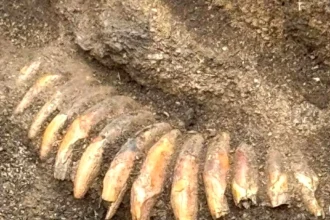
Amman, Jordan – Archaeological excavations in Jordan have unearthed a Byzantine-era olive press, along with the remains of an ancient church. This discovery adds new insights to the region’s history and the nature of its economic and religious life during that period.

(Photo/Yarmouk University Facebook page)
The distillery for the production of spirits
Preliminary findings suggest that the olive press was used for producing spirits,
reflecting an aspect of the economic activities and industries
that existed in local communities during the Byzantine era.
Excavation teams also unearthed the remains of an ancient church near the site.
This opens the door for researchers to study the nature of the populations that lived in the area
and their relationship to agricultural, commercial, and religious activities.

(Photo/Yarmouk University Facebook page)
The discoveries are subject to documentation and study
Archaeologists place particular importance on this type of discovery because it not only
reveals ancient buildings but also helps paint a clearer picture of daily life.
This includes methods of food and beverage production, as well as religious practices and social interactions.
The discoveries are currently undergoing documentation and study to accurately date the structures
and uncover further details about their use and the era in which they were built.
Jordan is rich in archaeological sites that reflect the succession of numerous civilizations and empires.
These discoveries add a new chapter to the history of the region during the Byzantine period.