
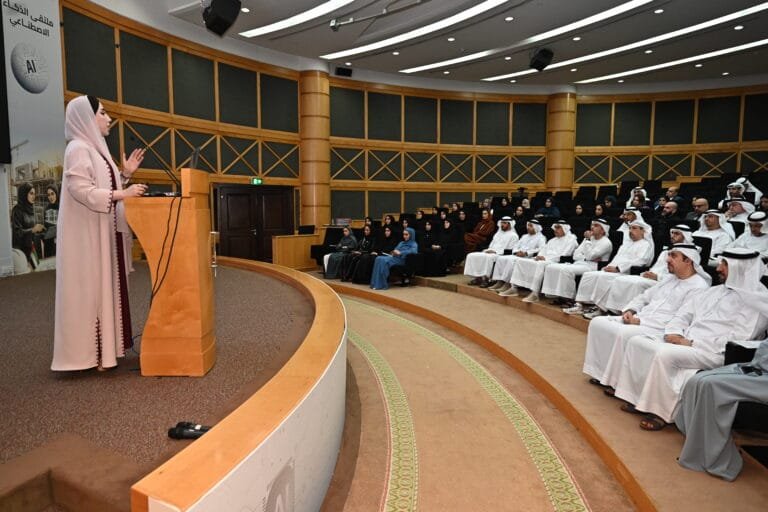
Abu Dhabi, UAE – The UAE Ministry of Energy and Infrastructure has announced the organization of the “First Artificial Intelligence Forum.” This initiative aims to accelerate the adoption of artificial intelligence in government services and enhance institutional performance. It also seeks to develop more agile and proactive digital solutions across the energy, infrastructure, and transportation sectors.
The ministry said in a press release that the forum saw the launch of a roadmap to expand the use of artificial intelligence technologies within its operations. This will be achieved through automating processes, streamlining procedures, and expediting government services. This supports the UAE’s drive to develop a more efficient and technologically advanced government model.
A roadmap for using artificial intelligence in government services
The forum is being organized as part of a federal initiative. This initiative is aimed at transforming 50% of the UAE government’s sectors and services within two years into “Agent AI” models. These models rely on systems capable of executing tasks. In addition, they support operational processes with a higher degree of autonomy.
The forum was attended by several ministry and government officials. Attendees included Sharif Al-Ulama, Undersecretary of the Ministry of Energy and Infrastructure for Energy and Petroleum Affairs. Mohammed Al-Mansouri, Undersecretary of the Ministry for Infrastructure and Transport Affairs, also attended. In addition, Hisham Amiri, Executive Director of Service Development at the Prime Minister’s Office, Ministry of Cabinet Affairs, was present.
The “First Artificial Intelligence Forum” program included specialized sessions on trends in adopting artificial intelligence in government work. In addition, brainstorming sessions were held to develop innovative initiatives and projects that support the Ministry of Energy and Infrastructure’s future objectives. This was done in preparation for their inclusion in the executive roadmap for smart transformation.
The AI Charter promotes digital governance
The forum also witnessed the signing of the “Artificial Intelligence Charter,” which the ministry stated aims to enhance digital governance and promote the responsible use of advanced technologies. This aligns with the goals of “We the UAE 2031.”
According to the statement, the charter reflects the commitment of the Ministry of Energy and Infrastructure’s senior leadership to implementing artificial intelligence objectives. It also aims to expand the use of digital solutions in developing government services. In addition, it focuses on improving performance efficiency.
Awards for innovation and eliminating bureaucracy
During the forum, the Ministry of Energy and Infrastructure announced the launch of the “Research and Innovation Award” and the “Minister of Energy and Infrastructure’s Artificial Intelligence Award for Zero Bureaucracy.” These awards aim to encourage national talent to develop innovative solutions. In turn, these solutions contribute to improving the efficiency of government operations and fostering a culture of institutional innovation. Furthermore, they seek to accelerate the transition towards more accessible and proactive services.
Sharif Al-Ulama stated that the shift towards autonomous AI models represents a significant leap forward in the development of government operations. This contributes to providing more efficient and proactive services. He also noted that the ministry is working on developing an advanced digital system. Moreover, this system supports innovation and the implementation of smart solutions.
For his part, Mohammed Al Mansouri explained that the use of artificial intelligence (AI) across the ministry’s sectors supports efficient planning and operations. It also contributes to developing solutions that enhance infrastructure resilience and service sustainability. He noted that the ministry began employing AI technologies in some of its processes several years ago. In addition, they were used in customer-related services. Hisham Amiri emphasized that accelerating the adoption of AI applications is a fundamental pillar in developing a more flexible, efficient, and proactive government model. He pointed out that smart technologies contribute to redesigning government services and procedures. In addition, they support efforts to reduce bureaucracy and improve customer experience.