- Egypt was among the first supporters of the establishment of the United Arab Emirates.
- Historic Emirati support for Egypt at pivotal moments
- A new phase of strategic partnership
- Economic partnership supporting sustainable development
- Political coordination to protect Arab security
- Extensive popular and cultural relations
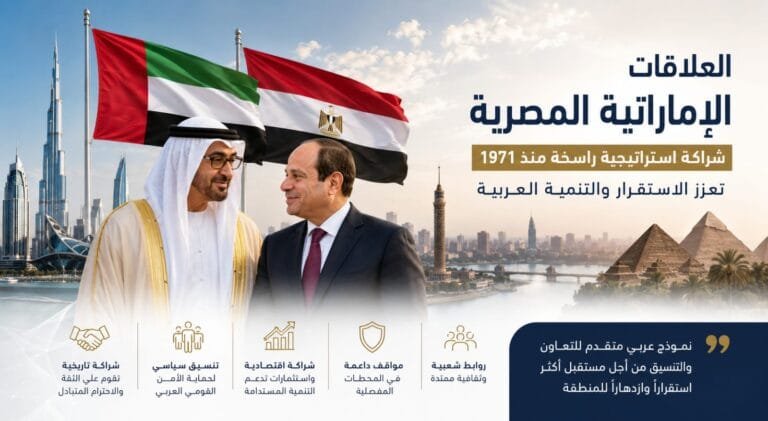
Cairo, Egypt – The relationship between the United Arab Emirates and the Arab Republic of Egypt represents a leading model of strategic Arab partnership, dating back to the founding of the UAE in 1971. For over five decades, the two countries have successfully built a comprehensive cooperation framework encompassing political, economic, developmental, and security aspects. This cooperation has also reached a level of close coordination on various regional issues.
From the very beginning of the UAE’s establishment, Cairo and Abu Dhabi have been keen to cultivate relations based on mutual respect and a shared vision for the stability of the Arab region. This stems from a firm conviction held by the leadership of both countries that Arab national security is an indivisible and interconnected whole.
Egypt was among the first supporters of the establishment of the United Arab Emirates.
The Arab Republic of Egypt was among the first Arab countries to recognize the establishment of the United Arab Emirates following the declaration of the Union on December 2, 1971. Egyptian expertise also played an important role in supporting the building phase of modern Emirati institutions, especially in the education, health, engineering and management sectors.
In contrast, the late Sheikh Zayed bin Sultan Al Nahyan established a firm approach to supporting Egypt. This stemmed from his belief in the pivotal role of Egypt in protecting Arab security and promoting regional stability.
Historic Emirati support for Egypt at pivotal moments
The UAE’s supportive stances towards Egypt have been evident during many historical events, most notably the October War of 1973. The UAE, under the leadership of Sheikh Zayed, stood by Egypt politically and economically, within the framework of the unified Arab position at that time.
During the 1990s, development cooperation between the two countries witnessed a significant expansion. This occurred particularly due to the close relationship between the UAE leadership and the late Egyptian President Hosni Mubarak.
Among the most prominent projects reflecting this cooperation is the UAE’s contribution to supporting the Toshka project, which aims to expand agriculture and reclaim land in southern Egypt. The project is considered one of the major strategic development projects.
Sheikh Zayed City also represents a prominent example of Emirati-Egyptian cooperation. The city was established with a grant from the Abu Dhabi Fund for Development and was named after Sheikh Zayed in recognition of his historic support for Egypt and its people.
A new phase of strategic partnership
In recent years, Emirati-Egyptian relations have witnessed significant development across various levels. This development has been supported by broad political consensus between the leaderships of the two countries on regional security issues and addressing shared challenges.
This cooperation was strengthened through the exchange of official visits and the signing of major economic and investment agreements. Coordination also continued on regional issues, most notably combating terrorism, supporting national state institutions, and maintaining regional stability.
The UAE has also become one of the largest Arab investors in the Egyptian market, through diverse investments that include the energy, real estate, ports, infrastructure, tourism, financial services and technology sectors.
Economic partnership supporting sustainable development
Economic relations between the two countries continue to register increasing growth rates, as both sides are keen to expand investment and trade cooperation. This aligns with the development visions of both countries.
Emirati investments play an important role in supporting development plans within Egypt, especially in infrastructure projects, new cities, renewable energy, transportation and logistics.
In contrast, the Egyptian market represents one of the most important strategic destinations for Emirati investments in the region, given Egypt’s geographical location, the size of its market, and its human and economic capabilities.
Political coordination to protect Arab security
On the political front, the UAE and Egypt share similar positions on various regional issues. These positions are based on supporting the stability of nation-states, rejecting foreign interference, and promoting political solutions to crises.
The two countries also continue their joint coordination on Arab national security issues. This reflects the depth of the strategic partnership between Abu Dhabi and Cairo, and the pivotal role both countries play in supporting regional stability.
Extensive popular and cultural relations
Beyond formal cooperation, Emirati-Egyptian relations are based on deep-rooted popular and cultural ties, underpinned by a large Egyptian community residing in the UAE. This community has contributed to the UAE’s development for decades, in addition to ongoing collaboration in the fields of culture, media, education, and the arts.
For over 55 years, the relationship between the United Arab Emirates and the Arab Republic of Egypt has maintained its unique political and strategic character. This relationship remains a model of Arab partnership built on mutual trust and a shared vision for development, stability, and shaping the future.