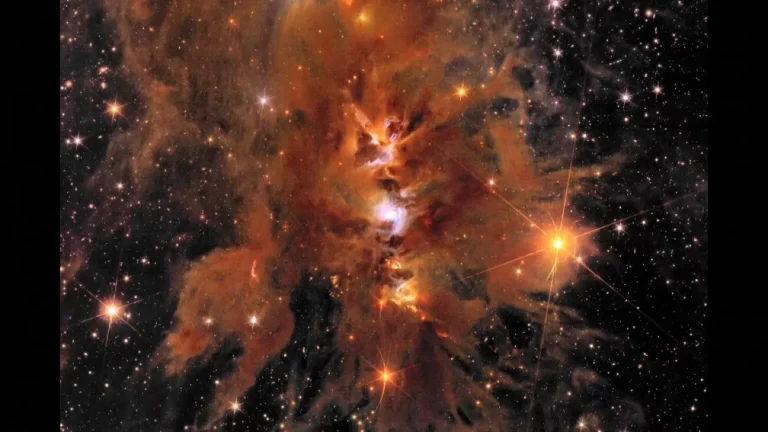
Paris, France – In an unprecedented scientific achievement, the European Space Agency’s Euclid Space Telescope has revealed the most detailed and precise image yet of the dense central region of our Milky Way galaxy.
In just 24 hours, the telescope captured data on more than 60 million stars, along with nebulae and star clusters, creating the widest and clearest optical mosaic of the galaxy’s visible light to date.
Exceptional potential that goes beyond goals
Although Euclid’s primary mission is to probe dark matter and dark energy in the universe, scientists have decided to point its unique lenses toward the heart of the galaxy.
Euclid’s strength lies in its ability to map vast areas of the sky with exceptional precision. It can cover a field of view 270 times larger than the Hubble Space Telescope in just a few hours. Furthermore, it maintains comparable image sharpness.
The telescope images reveal astonishing detail; a tiny fraction (0.003%) of the surveyed area represents thousands of stars. This gives a sense of the immense density of the “galactic bulge,” the spherical region containing approximately ten billion stars.
“The Microlens”: A window to discovering new worlds
This densely populated central region is an ideal natural laboratory for studying the phenomenon of gravitational microlensing. In this phenomenon, a star passing in front of another acts as a magnifying glass due to its gravity. This phenomenon is the key to discovering exoplanets. Moreover, these planets would otherwise remain invisible were it not for the bending of light caused by these celestial bodies.
“In the last 20 years, around 300 planets have been discovered in this way from ground-based telescopes, and Euclid’s image alone contains 51 known planetary systems, with the promise of discovering more,” explains researcher Jean-Philippe Beaulieu of the Institute of Astrophysics in Paris.
Time archive of the universe
The importance of this image lies not only in its captivating visual appeal, but also in its role as a “time reference” for scientists. By storing this data, astronomers can, in the future, when observing astronomical phenomena or microgravity lensing events with other telescopes such as the upcoming Roman Space Telescope, compare the current state of stars with Euclid’s image. Thus, this image serves as a reference to the past.
Valeria Petrino, director of the science program at the European Space Agency, points out that this data will allow for the study of exoplanets, brown dwarfs, and binary stars with unprecedented precision. Euclid succeeded in turning his gaze from the depths of the cosmos to our own home. Thus, he proved that our galaxy still holds within its folds tens of millions of stars waiting to have their scientific story told.