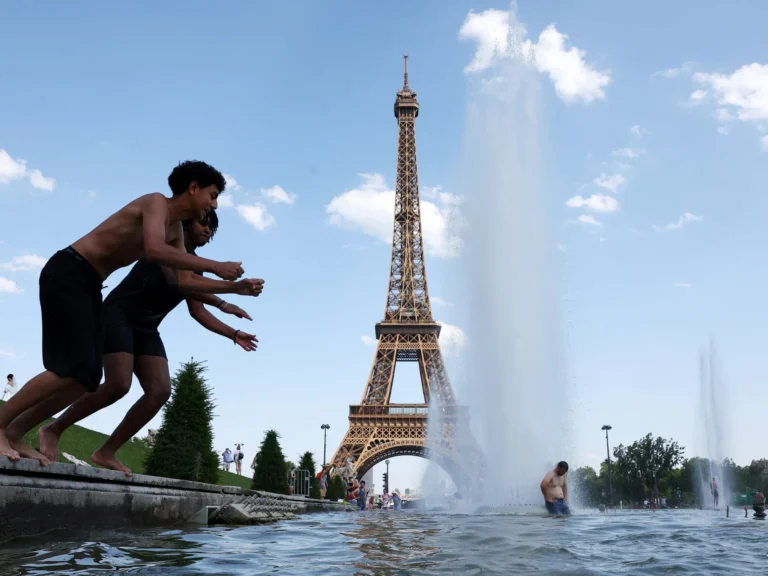
Paris, France – France is experiencing one of the most severe heat waves in its modern history, with temperatures in many areas exceeding 40 degrees Celsius. As the country struggles to cope with the health and social consequences of this phenomenon, air conditioning has become the focus of a fierce political battle between Marine Le Pen, leader of the far-right party La France Insoumise (France Unbowed), and Jean-Luc Mélenchon, leader of the party. This dispute reflects more than just a difference of technical views; it reveals a broader strategic struggle over how France will address the climate crisis and its inevitable repercussions before the 2027 elections.
Le Pen’s plan: “Air conditioning” as essential infrastructure
Marine Le Pen and her National Rally team are adopting an approach based on direct and widespread intervention. Her party is proposing an ambitious program to install air conditioning extensively in vital institutions, particularly schools, hospitals, and nursing homes.
The party’s strategists argue that air conditioning is no longer a luxury, but rather a “basic infrastructure” on par with heating services during the winter.
The proposal extends beyond public institutions; the National Rally is considering offering financial incentives and subsidized loans to citizens and businesses to install these systems. However, this vision clashes with public opinion; polls by the Elabe Institute indicate that two-thirds of the French view air conditioning as a temporary solution and prefer sustainable investments that do not increase environmental burdens.
Mélenchon: Warning of a “vicious cycle”
In stark contrast, Jean-Luc Mélenchon takes a confrontational stance against the indiscriminate proliferation of air conditioners. He warns that installing these devices everywhere could lead to a “vicious cycle,” as they release the absorbed heat into the city’s external environment. This exacerbates the urban heat island effect and increases excessive energy consumption.
Instead, Mélenchon advocates for a “structural adaptation” strategy, which focuses on upgrading building insulation, improving shading systems, and enhancing natural ventilation. He also seeks to expand green spaces to reduce the need for mechanical cooling.
The French Left: A New Realism in the Time of Climate
Despite its hardline stance, observers note a shift in the rhetoric of “France Unbowed.” Today, the left acknowledges that adapting to the inevitable consequences of climate change has become a priority on par with reducing emissions.
The left’s updated plan includes using air conditioning only as a last resort and when absolutely necessary, in hospitals, nursing homes, and schools. Under normal circumstances, it prefers fan systems and shading. Left leaders admit that previous predictions about the possibility of rapidly curbing global warming have become less optimistic. This has made adaptation a “survival imperative.”
The climate crisis is at the heart of the 2027 elections.
This debate goes beyond the details of “air conditioners” to the core of the French political debate: How does France live in a warming world? While Sebastien Lecorne’s government faces harsh criticism for “lack of preparedness,” data shows that more than half of the French population feels the country is unprepared to face extreme weather events.
The recurring heat waves have brought deaths to the forefront of public attention. In recent days, a child tragically died inside a car, while authorities in Paris were forced to ban alcohol consumption in public places.
As these phenomena intensify, experts agree that the climate crisis will be a driving force in the upcoming presidential elections. In these elections, candidates will have to present practical visions that go beyond slogans, whether through options like “mechanical cooling” or “sustainable green solutions.”