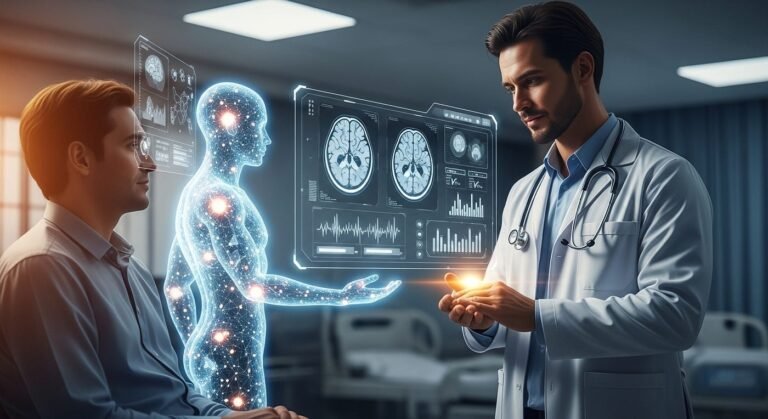
London – Medical schools and hospitals worldwide are locked in a heated debate over the “digital beast” beginning to permeate operating rooms and radiology centers. With the stunning evolution of AI systems capable of analyzing minute details in scans and suggesting treatment protocols, the question in May 2026 is: will the stethoscope soon become a relic of the past? Obviously, the challenge lies not just in diagnostic speed, but in the machine’s ability to compete with years of human experience and medical intuition.
“Beyond Human Accuracy”: When Algorithms Win the Big Data Battle
Recent medical studies have revealed “shocking” results, showing AI models detecting malignant tumors and heart diseases with accuracy that matches, and often exceeds, top consultants. Accordingly, tech advocates argue that machines excel in tasks requiring the scanning of massive amounts of medical data in seconds without fatigue or distraction. Clearly, this development significantly reduces the margin of human error, especially in early diagnosis cases where every second counts.
“Emotional Intelligence”: Why Doctors Won’t Vanish from the Scene?
Despite all this progress, health experts agree that AI is “one-eyed”; it sees symptoms but not the human being. As a result, “human judgment” based on understanding a patient’s psychological state and social circumstances remains the missing element in algorithms. A patient doesn’t just need a dry mathematical decision; they need a doctor who understands their fears and reads between the lines of their medical history. In this landscape, the world is moving towards “Hybrid Medicine”—where the machine acts as a smart assistant enhancing the doctor’s precision, while the human remains the final authority in the healthcare system.