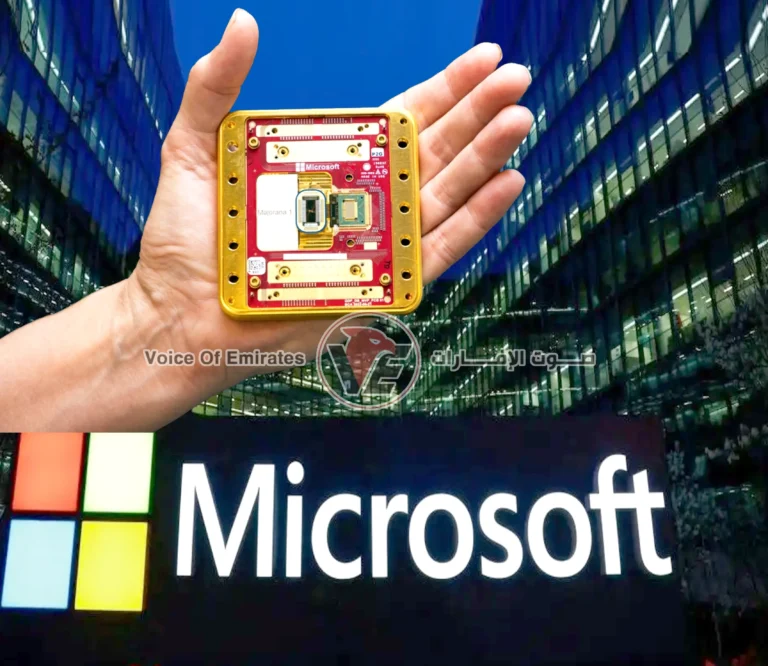
Washington, DC – Companies specializing in quantum computing, including Microsoft, Atom Computing, and AeroQ, have unveiled new developments in their research programs aimed at accelerating the development of practical quantum computers.
This comes amid a growing global race between major technology companies and startups to develop this promising technology.
Microsoft is developing topological qubits
A recent report explained that these achievements are not revolutionary breakthroughs, but rather reflect the gradual progress necessary for the development of quantum computing.
Major successes in this field depend on the accumulation of a long series of technical and engineering improvements.
Microsoft is one of the few companies working on developing what are known as topological qubits.
These are quantum processing units that rely on unique physical properties arising when particles are confined in specific environments.
The model the company is developing is based on a superconducting wire placed on top of a semiconductor material.
In this context, electron pairs known as Cooper pairs are formed.
When there is an odd number of conductive electrons, the unpaired electron can be distributed
between the ends of the wire according to the laws of quantum mechanics.
Broad future challenges and prospects
Researchers emphasize that achieving commercially viable quantum computers requires overcoming a range of technical challenges,
most notably improving qubit stability, reducing error rates, and increasing the systems’ scalability and operational capacity.
Development companies are also working on new methods to control quantum systems and enhance their reliability.
These are essential steps before moving to mass commercial production.
Technology experts believe that quantum computing could revolutionize numerous sectors,
including artificial intelligence, cybersecurity, pharmaceutical development, and complex data analysis.
Despite ongoing progress, specialists point out that there is still a long way to go
before quantum computers can deliver widespread practical benefits.
However, current developments represent significant steps toward achieving this goal.