
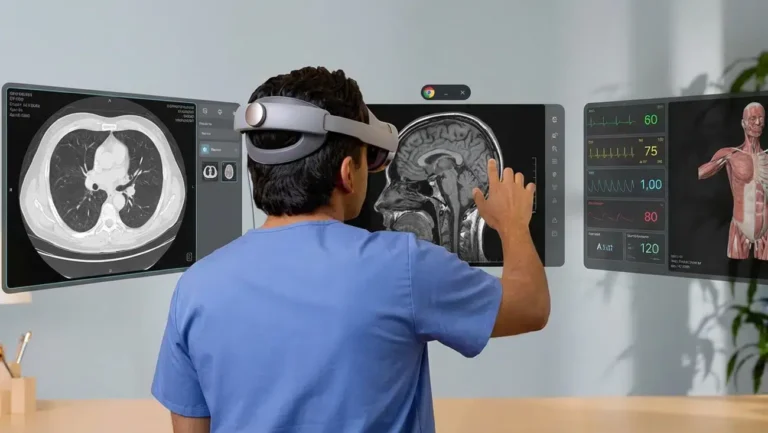
California – The concept of “Spatial Computing” and Extended Reality (XR) has begun to transcend the framework of entertainment and gaming, establishing itself as a fundamental pillar in business and healthcare. This field is witnessing a true surge as organizations adopt these technologies for professional training and cross-border medical collaboration, ending an era where these tools were considered mere technical luxuries.
The success of Extended Reality (which encompasses VR, AR, and MR) relies on its ability to seamlessly merge the digital world with the physical reality, allowing users to interact with 3D virtual objects as if they were part of their real environment, opening a new door for operational efficiency and professional innovation.
A Revolution in Enterprise Training and Remote Healthcare
In the corporate sector, XR has become the preferred tool for training employees on high-risk or high-cost tasks. These technologies allow engineers and technicians to practice maintaining jet engines or managing nuclear plants within virtual environments that simulate reality with extreme precision and zero risk. Studies have shown that training via spatial computing significantly reduces learning time and increases information retention compared to traditional methods.
In healthcare, XR has revolutionized “remote medical collaboration.” Surgeons in different geographic locations can now work together on a 3D model of a patient’s heart before surgery or even provide real-time guidance via AR glasses during an operation. This development not only improves surgical precision but also grants remote areas access to global medical expertise that previously required expensive travel and costs.
The Future of Human Interaction with Spatial Data
Tech analysts believe that spatial computing is the next stage in the evolution of user interfaces, where screens will move from our phones and computers to become part of the space around us. As device precision improves and costs decrease, XR headsets are expected to become an integral part of the modern office environment, replacing multiple monitors with infinite digital workspaces that enhance human capacity for data analysis and “virtual” collaboration with colleagues as effectively as in-person presence.
In conclusion, the rise of XR in the workplace represents a shift from “viewing” digital content to “living” inside it. While challenges like device comfort and battery life remain, the added value these technologies provide in medicine, industry, and training confirms that spatial computing will redefine the concepts of the “office” and the “hospital” in the near future.