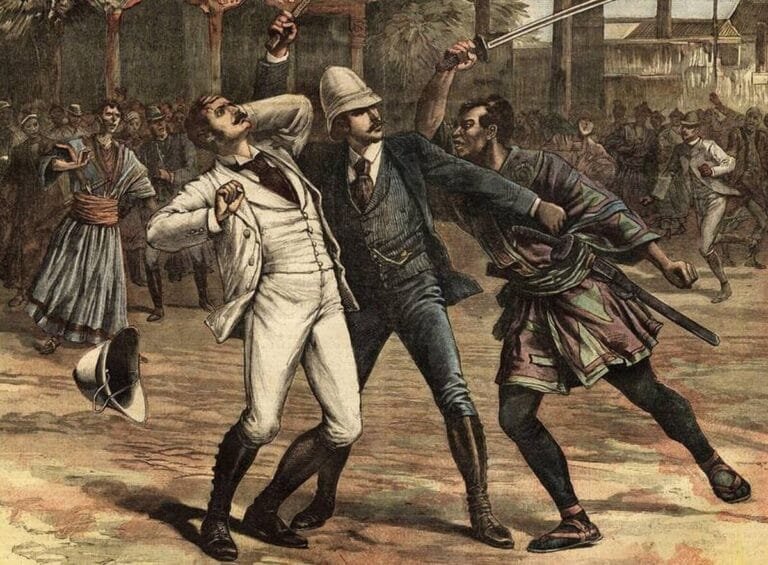
Tokyo – The “Otsu Incident” is classified as one of the most dangerous political turning points in the history of international relations at the end of the 19th century. In 1891, a failed assassination attempt targeting the then-Russian Crown Prince, Nicholas Alexandrovich, almost triggered an early military confrontation between the Russian and Japanese Empires, at a time when superpowers were scrambling for influence in the Far East.
The Russian Crown Prince (who later became Tsar Nicholas II) was on a major diplomatic tour aimed at strengthening ties with Asian nations. While passing through the Japanese city of Otsu, a Japanese policeman named Tsuda Sanzo lunged at him with a sword, inflicting slash wounds on his head. This strike was not just a physical assault; it was a spark that nearly incinerated years of diplomatic efforts.
Japanese Mobilization and Imperial Apology to Contain the Disaster
The incident sparked a state of political panic within the ruling circles of Japan. The Japanese government feared that Russia, a superpower at the time, would use the attack as a pretext to invade the country or impose harsh political and economic sanctions. Tokyo rushed to offer unprecedented official apologies; Emperor Meiji himself personally visited the injured Crown Prince to express his deep regret—a rare move that reflected the magnitude of Japanese concern over the repercussions.
On a popular level, a sense of grief and anxiety prevailed. Thousands of Japanese citizens sent telegrams of apology, and some even performed acts of penance to express the people’s innocence from the policeman’s rogue action. These intensive efforts succeeded in containing Russian anger at the time, and the attacker was tried under local laws, sparing both countries an armed confrontation that seemed imminent.
Psychological and Political Impact: The Seeds of the 1904 War
Although the crisis was successfully defused diplomatically, historians argue that the “Otsu wound” never truly healed in the psyche of the future Tsar Nicholas II. The incident birthed a sense of hostility and suspicion toward Japan and its people, which clearly influenced his later political decisions. It is believed that this psychological background contributed to the hardening of Russian positions during the competition for influence in Manchuria and Korea, ultimately leading to the outbreak of the Russo-Japanese War in 1904.
In conclusion, the Otsu Incident remains a stark historical example of how a sudden individual event can reshape the strategies of superpowers. The event confirms that history is not made solely by agreements and treaties, but sometimes by a stray sword strike or a bullet not fired, leaving scars in the memories of rulers and kings that shift the global balance of power for decades to come.