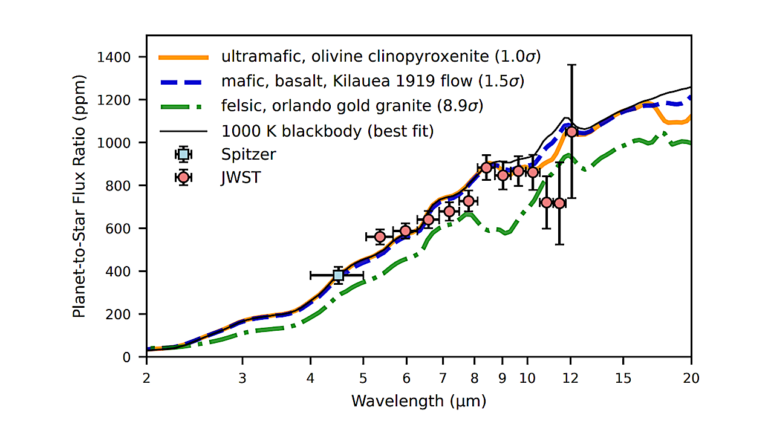
Washington – In a scientific breakthrough that marks a first in the history of space exploration, the James Webb Space Telescope (JWST) has surpassed all expectations by studying the surface features of a planet located outside our solar system. Obviously, by May 2026, we are no longer limited to analyzing the gases surrounding exoplanets. Thanks to Webb’s advanced light and infrared analysis, it can now “touch” the surface from afar, capturing physical and structural details that were considered science fiction until recently.
“Beyond the Atmosphere”: How Did JWST Manage to See the “Rocks” of Distant Planets?
Astronomers clarified that previous research could only “sense” the components of the air surrounding exoplanets. Today, we have moved into the stage of “direct observation” of surface characteristics. Accordingly, the data showed subtle differences in temperature and soil composition, helping determine if the planet is rocky like Earth or possesses elements potentially suitable for life. Clearly, the precision of Webb’s instruments has granted us this superior “visual power” to pierce the vast distances separating us from these distant worlds.
“The Era of Finding Earth 2.0”: Are We Closing in on Life Beyond Our System?
Experts believe this development marks the dawn of a new era in astronomy; we can now classify exoplanets based on the habitability of their “ground,” not just their “air.” As a result, JWST’s status as the greatest research tool of the modern age has been solidified, placing humanity on the verge of discoveries that could reshape our understanding of our place in this vast universe. In this landscape, the big questions about extraterrestrial life await answers that may come soon with every new “image” sent by this celestial giant.