
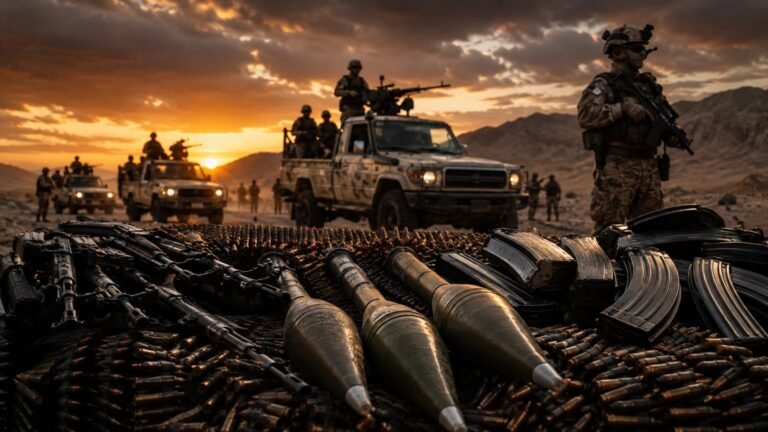
- Aswan raid: Large quantities of ammunition seized
- Accumulated total since the beginning of the year
- Weapons, drugs, and gold: intertwined criminal networks
- Preventing weapons from entering
- A multi-layered system for securing borders
- Regional challenges necessitate stricter oversight.
- Targeting networks, not just seizures
- Border protection is part of national security.
- Control operations are ongoing
Cairo, Egypt – Seizures announced by the Egyptian Armed Forces during 2026 reveal the continuation of border security operations and the pursuit of arms and ammunition smuggling networks. This comes within the framework of a security system aimed at preventing the transfer of illicit weapons into the country. Moreover, it is aimed at cutting off funding sources and activities of transnational organized crime networks.
The latest operations in this context took place in Aswan Governorate, where the Armed Forces announced the thwarting of two smuggling operations in the governorate’s desert hinterland. These operations resulted in the seizure of 24 weapons of various types and 49,211 rounds of ammunition of different calibers. In addition, other contraband was seized. The forces continued to pursue the remaining members of the smuggling network.
Aswan raid: Large quantities of ammunition seized
The significance of this latest operation lies in the quantity of ammunition seized and the nature of the activity it targeted. It was part of ongoing security operations to pursue criminal networks operating across border and desert regions. This prevents weapons from reaching areas of criminal activity within the country. Military statements released throughout the year indicate that combating arms and ammunition smuggling is a key focus of the Border Guard forces’ operations. They operate across the country’s strategic directions.
Accumulated total since the beginning of the year
In a report released during March, the forces announced the seizure of 28 weapons and ammunition in separate incidents. These resulted in the confiscation of 315 firearms and 10,538 rounds of various types of ammunition. In another report released during June, 33 weapons and ammunition in similar incidents were announced. This resulted in the seizure of 96 firearms and approximately 3,600 rounds of various types of ammunition. Additionally, there were other seizures related to drugs, smuggling, and illegal gold mining.
Weapons, drugs, and gold: intertwined criminal networks
The operations announced simultaneously reveal the overlap between arms smuggling and other criminal activities, particularly drug trafficking, illegal gold mining, and illegal immigration. These activities sometimes exploit the geographical nature of desert and border regions. Moreover, they exploit the vastness of their routes. This overlap makes confronting smuggling networks a multi-dimensional security issue. It is not limited to seizing weapons but extends to dismantling the criminal infrastructure behind their transport, storage, and distribution.
Preventing weapons from entering
The importance of controlling arms shipments at the borders extends beyond simply preventing their entry into Egyptian territory. It also prevents them from reaching organized crime networks within the governorates. Therefore, thwarting smuggling operations in their early stages is a crucial component of the security system. These measures become even more critical when the shipments are large. This is because their arrival at their final destinations could have provided quantities of weapons and ammunition to individuals and networks involved in various criminal activities.
A multi-layered system for securing borders
Border security operations, as previously announced by the armed forces, rely on a system combining monitoring, surveillance, patrols, and field deployment. This is complemented by available intelligence on smugglers’ movements and the routes used in their transport operations. This system works to detect and address suspicious movements before shipments reach their intended destinations within the country.
Regional challenges necessitate stricter oversight.
The Egyptian measures come amid escalating regional security challenges. Large swathes of the Middle East and North and East Africa are witnessing the activity of cross-border smuggling networks. Furthermore, illicit markets for weapons and drugs are proliferating. This environment compels countries with extensive borders to strengthen their capabilities to monitor crossings and desert routes. It also compels them to pursue the networks that exploit borders to transport weapons and prohibited materials.
Targeting networks, not just seizures
The seizures announced by Egypt this year reflect a trend toward treating smuggling as an organized activity rather than isolated incidents, especially when investigations reveal the involvement of multiple parties in transportation, storage, and distribution. In the recent Aswan operation, the pursuit of the remaining members of the network continued after the shipment was seized. This was a step aimed at apprehending those involved in the smuggling operation. It was not merely about confiscating the seized weapons and ammunition.
Border protection is part of national security.
Border protection occupies a central position in Egypt’s national security system, serving as the first line of defense against the infiltration of threats and illicit activities from surrounding regional environments into the country. Within this framework, combating arms smuggling is one of the issues the armed forces address. They also focus on combating drug trafficking, illegal immigration, and smuggling in all its forms.
Control operations are ongoing
The events announced in recent months indicate continued security pressure on smuggling routes, with seizures recorded in various areas. The most recent and notable of these, in terms of the quantity of ammunition seized, was the operation in the desert hinterland of Aswan. These arms and ammunition seizures in 2026 are part of a broader system for securing Egypt’s borders. This system aims to prevent border areas from becoming conduits for arms trafficking or bases for organized crime activities. It also aims to maintain the state’s ability to control the movement of people, goods, and hazardous materials across its borders.