London, Britain – The Guardian newspaper reported that the escalating Houthi military attacks on Saudi territory could represent the first practical test of the “Mecca Agreement for Joint Defense.” This agreement was recently signed by Saudi Arabia, Turkey, and Pakistan.
A new Islamic alliance modeled after NATO
The newspaper reported that the joint defense agreement has placed three of the most influential countries in the Islamic world in a massive strategic alliance. This alliance is modeled on NATO. Meanwhile, Riyadh faces ongoing attacks from the Iranian-backed Houthi rebels in Yemen. The newspaper added, “The Houthis and Saudi Arabia intensified their exchange of military attacks last month, and Yemen may be the first test of this long-prepared tripartite agreement.”
The newspaper pointed to recent Houthi attacks using ballistic missiles and drones, which killed at least 58 Yemeni government soldiers stationed in Aden. In addition, 11 civilians were injured in a separate attack targeting southern Saudi Arabia. Assessments suggested that Riyadh was preparing for a large-scale military operation against the Houthis. This operation could possibly come from the sea and possibly also from the land.
Details of the “Mecca Agreement” for joint defense
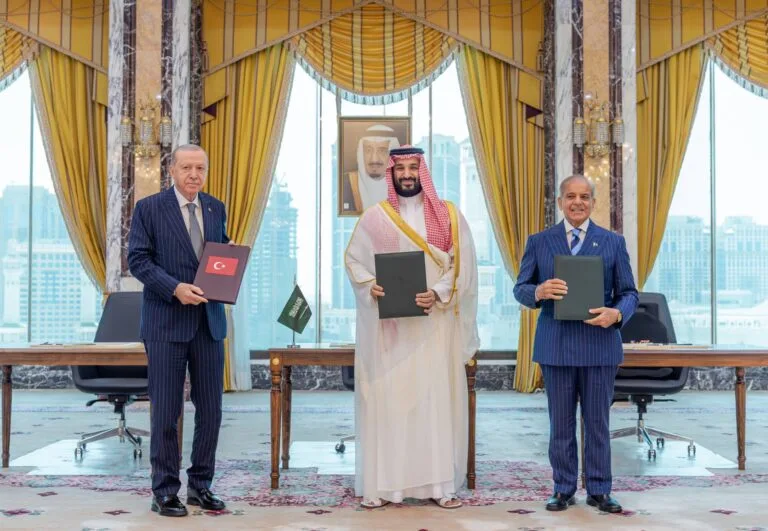
Saudi Crown Prince Mohammed bin Salman, Prime Minister of the Kingdom, Turkish President Recep Tayyip Erdoğan, and Pakistani Prime Minister Shehbaz Sharif signed a joint defense agreement in Mecca. The signing coincided with a trilateral summit hosted by the Kingdom. President Erdoğan also arrived for a one-day working visit at the invitation of the Saudi government. He participated in the summit.
The agreement explicitly states that any armed attack on any one of the three countries is considered an attack on all three. This step is an extension of the bilateral agreement signed by Riyadh and Islamabad in September 2015. That agreement stipulated that “any aggression against either of the two countries is considered an aggression against both.”
Alliance goals and joint capabilities
Reports indicate that the new alliance aims to bolster regional security amidst the prevailing geopolitical uncertainty. Pakistan contributes its nuclear capabilities and highly trained military. Saudi Arabia offers substantial capital and significant political influence. Meanwhile, Turkey provides its advanced defense industry and armed forces with extensive field operational experience.
This high-level meeting between the three leaders reflects the growing level of strategic coordination between their countries. It also underscores their shared commitment to strengthening effective partnerships across various issues of mutual interest. This happens amidst escalating security challenges in the region, most notably the Yemeni crisis.