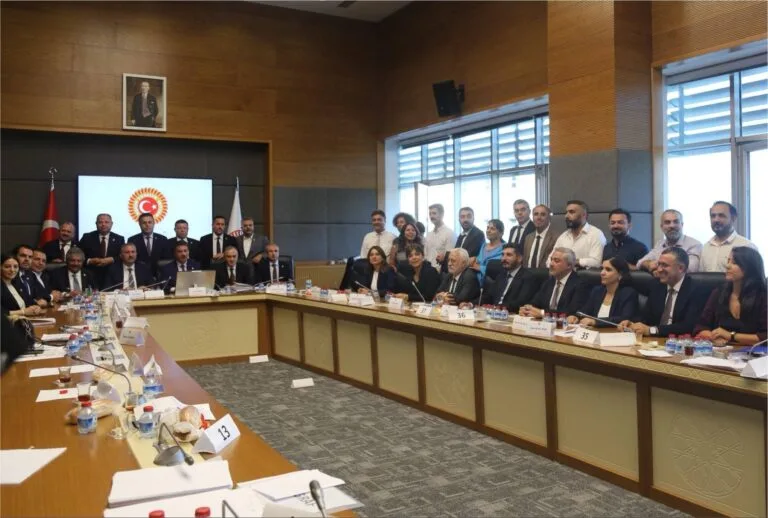
Ankara, Turkey – The Justice Committee of the Turkish Parliament approved, by vote, the draft law on “Strengthening Social Unity and National Support,” submitted within the framework of the Peace and Democratic Society Process with the Kurds of Turkey, led by Abdullah Öcalan, the leader of the Kurdistan Workers’ Party (PKK). The draft will be formally referred to the General Assembly of Parliament after 48 hours.
The approval of this framework law – prepared as a key component of the new peace process – came after intensive meetings and lengthy, marathon discussions that lasted nearly 18 hours (17 hours of continuous debate and argument). Notably, these discussions were marked by sharp political tensions and divisions of opinion among the various parliamentary blocs. Opponents summarized the process with the slogan: “The law has been passed, but democracy has not been fully achieved.”
Details of the marathon parliamentary meeting
The discussion of the framework bill, officially titled “Bill for Strengthening National Solidarity and Social Integration,” began in the Justice Committee of Parliament at 3:30 PM the day before yesterday. The bill received joint signatures from major parliamentary blocs, including the Justice and Development Party (AKP), the Nationalist Movement Party (MHP), and the Democracy and Equality Party (DEVA). Individual signatures were also received from the Republican People’s Party (CHP), the Hüda-Par Party (HÜDA PAR), and the Yeni Yol Party (YENYOL). After a difficult period of debate, the committee approved the bill at 9:00 AM the following day. However, while there was a general consensus on passing the bill, the meeting room witnessed frequent arguments and outright rejection of opposition proposals to abolish the crimes of “publicly disseminating false information” and “insulting the president.” Furthermore, demands to end the practice of appointing government trustees to local municipalities instead of elected mayors were also rejected.
Sharp tensions and verbal clashes between opposition and coalition MPs
Tensions repeatedly escalated during discussions of the proposed legislation. Murad Amir, deputy head of the New Party bloc, criticized the government’s measures. He emphasized in his speech that the proposal was hastily prepared and contained serious flaws. In addition, Amir questioned the feasibility of eliminating terrorism without establishing the foundations of genuine democracy. He stated, “We have drafted a law, and we will eliminate terrorism and silence the guns. Let’s do this now, and we’ll talk about democracy later. We have never accepted this approach, and we continue to reject it.”
The discussion also touched on the issue of elected mayors, with Emir describing the government’s actions against them as a “coup.” Moreover, he questioned the reasons for excluding political figures like Selahattin Demirtaş. This sparked a heated exchange with Saruhan Oluç, a member of parliament from the Democracy and Equality Party. For his part, Oluç emphasized that Demirtaş is not a tool for partisan consumption but a symbol of shared struggle.
During the session, a heated procedural dispute erupted between İyi Party MP Rıdvan Öz and Commission Chairman Cüneyt Yüksel regarding the mechanisms for managing the debate and allocating speaking time. This disagreement nearly escalated into a confrontation before other MPs intervened to defuse the tension. A heated verbal exchange also broke out between İyi Party and Nationalist Movement Party MPs over political and historical assessments. Furthermore, this dispute was accompanied by protests and minor scuffles that were quickly contained before they could escalate further.
Rejecting the democratic proposals and final approval of the law
Regarding legislative amendments, the New Party submitted a package of proposals to amend the law’s title to “Draft Law on Strengthening National Solidarity, Fraternity, Democracy, and Social Integration.” The party also proposed including clear provisions in Article 1 concerning local administrations, the judicial system, and freedoms. In addition, the party further added proposals to remove restrictions on freedom of expression. Despite the rejection of these reform proposals, the sessions concluded with the New Party and the signatory parties voting in favor of the framework law. Thus, the draft law received near-unanimous approval, including from the Justice and Development Party, the Nationalist Movement Party, the Democracy and Equality Movement, the New Party, and the Republican People’s Party. In contrast, the opposition forces maintained their commitment to continuing the political struggle to ensure the completion of the comprehensive democratic transition in Türkiye.