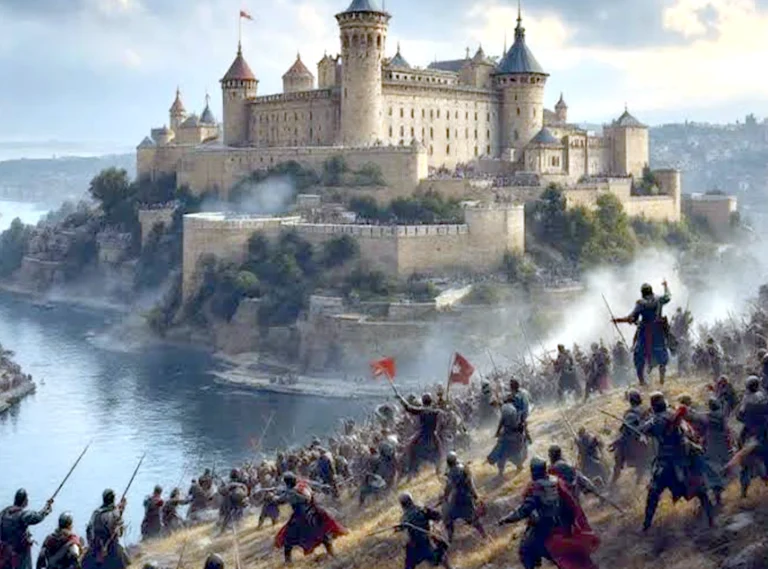
Belgrade, Serbia – The conquest of Belgrade in 1521 marked a pivotal moment in Ottoman history, as Sultan Suleiman the Magnificent wrested the city from Hungarian control.
He then transformed it into a strategic base that bolstered the Ottomans ability to advance into Central Europe.
The Ottoman campaign began in the summer of 1521,
targeting Belgrade due to its military and geographical importance.
Situated at the confluence of the Danube and Sava rivers,
it served as a key stronghold protecting the route into Hungarian territory.
A major shift in the balance of power in the region
The Ottoman army laid siege to the city from several directions,
using artillery, land forces, and riverine troops to pressure the defenders.
After weeks of resistance, Belgrade fell to the Ottomans, becoming a crucial base for their subsequent campaigns.
The city’s fall was not merely a military victory; it significantly altered the balance of power in the region,
removing one of the most important obstacles to Ottoman expansion into Hungary and Central Europe.
A strategic gateway for the Ottoman Empire
A few years later, Suleiman the Magnificent continued his campaigns in Europe,
culminating in the Battle of Mohács in 1526, which ended in a decisive Ottoman victory over the Hungarian army.
As a result, Belgrade became associated in historical memory with the beginning of
a new era of powerful Ottoman presence in the heart of Europe.
Thus, Belgrade was transformed from a border fortress into a strategic gateway for the Ottoman Empire.
Its conquest became one of the most significant early military achievements of Suleiman the Magnificent’s reign.
This era later witnessed extensive Ottoman expansion into Europe, Asia, and the Middle East.