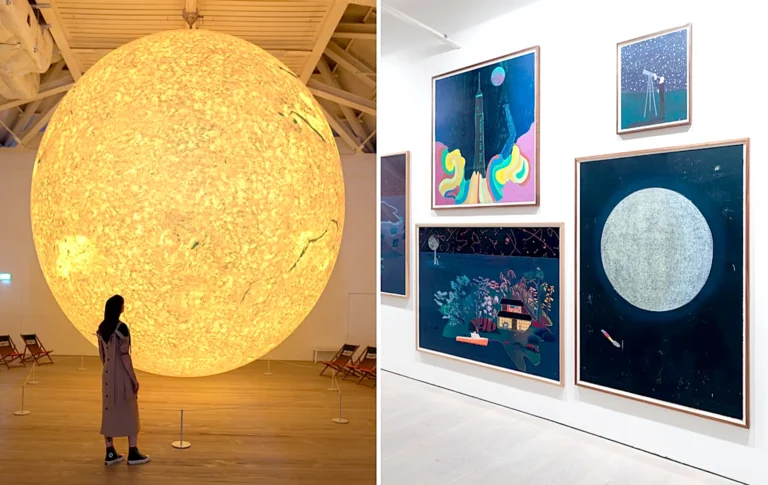
Paris, France – The “Sun and Moon” exhibition offers a historical and artistic journey through civilizations.
It explores the place these celestial bodies have held in the beliefs and cultures of different peoples.
The exhibition also demonstrates how the sun and moon have become religious, intellectual,
and artistic symbols that have accompanied humankind for millennia.
The exhibition brings together artifacts, artworks, and historical documents.
These elements illuminate the diverse ways in which different civilizations have interpreted
the movements of the sun and the phases of the moon.
The exhibition also highlights the rituals, myths, and systems of timekeeping
and seasonal patterns associated with these celestial bodies.
Organizing the lives of ancient societies
The exhibition reveals how observing the sky was more than just a means of understanding natural phenomena.
In fact, it played a crucial role in organizing the lives of ancient societies.
For example, it contributed to determining planting and harvesting dates,
as well as the development of calendars and the connection of astronomical phenomena to religious events.
The exhibition also traces the evolution of the image of the sun and moon in art.
As a result, they appeared in engravings, sculptures, manuscripts, and paintings as symbols of power, life, and renewal.
Conversely, in other cultures, the moon was associated with cycles of time, transformation, and mystery.
Man’s relationship with the heavens
“The Sun and the Moon” offers visitors a chance to discover how different civilizations viewed the sky.
Despite these differences, they shared a common fascination with the celestial bodies
that illuminated the human world and drove people to seek explanations for what they saw above.
The exhibition emphasizes that humanity’s relationship with the sky extended far beyond astronomical observation.
It significantly shaped culture and collective imagination. Thus, the sun and moon remain
among the most prominent symbols in the history of human civilizations.